Premium Managed Offices
Every Gurugram commercial corridor has had its moment — MG Road in the 2000s, Cyber City through the 2010s, Golf Course Road as its more residential-adjacent sibling. Golf Course Extension Road's rise over the last several years is different from those earlier waves in one important way: it wasn't driven primarily by one anchor developer or one marquee tenant. It was driven by infrastructure catching up to demand that had already arrived.
That distinction matters for anyone deciding where to put an office today. A corridor that grows because infrastructure improved tends to keep growing, because the underlying capacity constraint has been removed. A corridor that grows because of a single high-profile development is more fragile — its trajectory depends on that one anchor continuing to perform. Golf Course Extension Road, and Sector 66 in particular, falls into the first category, and that's the core reason it's become Gurugram's most credible claim to a "new CBD."
The connectivity story, in specifics
Golf Course Extension Road sits in an unusually well-served position relative to Gurugram's broader arterial network. It connects directly to Sohna Road to the south and to NH-48 to the west, giving it two of the region's highest-capacity routes without requiring a detour through the older, more congested core of the city. For a business with staff commuting from South Delhi, Faridabad, or the newer residential clusters along Sohna Road, that means a materially shorter and more predictable commute than an office located in the older Cyber City or MG Road belt.
The Rapid Metro extension and the ongoing widening and signal-free work along the corridor have compounded this advantage rather than simply maintaining it. Roads that were genuinely congested five years ago now move meaningfully faster during peak hours, and that kind of improvement changes hiring calculus in a way that's easy to underestimate — a 20-minute reduction in average commute time is a real, measurable factor in offer acceptance rates for mid-level and senior hires who are weighing multiple job offers across the NCR.
Why Sector 66 specifically has become the epicenter
Within the broader Golf Course Extension Road corridor, Sector 66 has emerged as the specific stretch where Grade A commercial development has concentrated most heavily. Part of this is simple geography — Sector 66 sits at a point on the corridor with strong access to both the extension road itself and the cross-connectors toward Golf Course Road proper, giving tenants a genuine choice of routes depending on where their team is commuting from. Part of it is also a self-reinforcing cluster effect: once two or three major commercial towers established themselves in Sector 66, the ecosystem that follows — F&B options, banking branches, service providers, other businesses wanting proximity to potential clients and partners — accelerated in a way that's hard to replicate by simply building a tower somewhere else on the corridor.
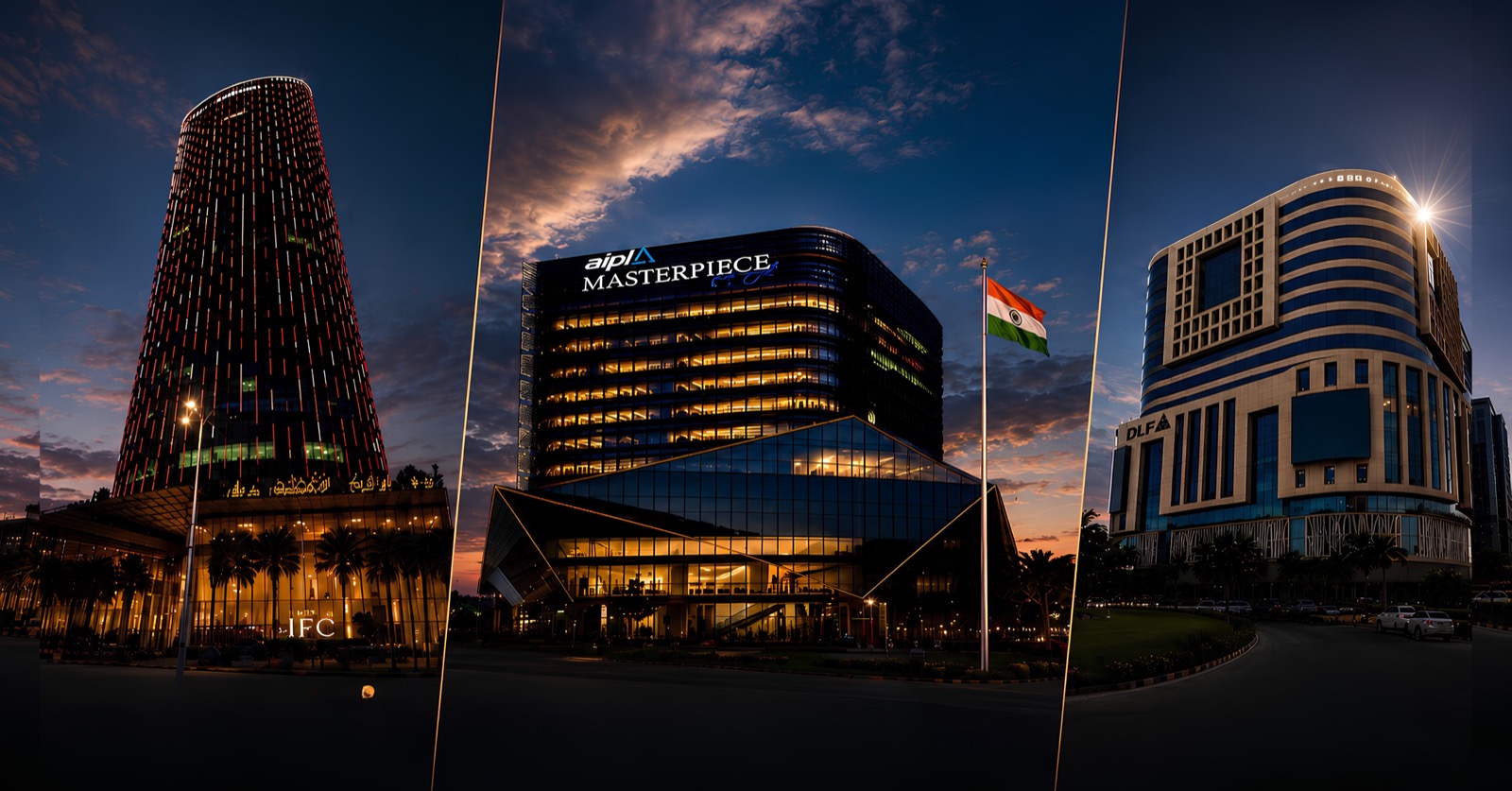
Qaarya's own flagship location sits inside M3M International Financial Centre in Sector 66, and the pattern we see in daily tenant conversations reflects exactly this dynamic. Companies choosing this location aren't usually choosing it in isolation — they're choosing it because a client, a partner, or a competitor is already nearby, and proximity compounds in ways that are hard to quantify precisely but are very real in practice, from casual meetings that turn into deals to the simple convenience of scheduling in-person conversations without a 45-minute drive across the city.
The businesses actually driving demand
The tenant mix moving into Sector 66 and the broader Golf Course Extension corridor tells its own story about where Gurugram's economy is heading. Financial services and fintech firms have been particularly active, drawn partly by the "financial centre" positioning of towers like M3M IFC and partly by proximity to the talent pool that's increasingly choosing to live along Sohna Road and the newer residential sectors rather than commuting in from Delhi. Alongside them, a steady wave of mid-sized technology and SaaS companies — past the earliest coworking stage but not yet at the scale where they'd build a dedicated campus — have gravitated toward managed office space in the corridor specifically because it offers Grade A infrastructure without the multi-year commitment of a ground-up build.
Professional services firms — law, consulting, and advisory practices serving the broader NCR corporate market — have also moved in meaningful numbers, often citing client perception as a factor as much as connectivity. Bringing a client to a tower with a strong lobby, reliable power, and a recognizable business address in a corridor with obvious momentum sends a different signal than the same meeting held in an older or more peripheral location, even if the actual office square footage is identical.
What's pulling businesses specifically toward Sector 66
- Dual highway access via Sohna Road and NH-48, reducing dependence on any single congested route.
- A growing residential base along Sohna Road and Golf Course Extension itself, shortening commutes for a large share of the talent pool.
- Grade A tower density that's reached a critical mass, creating the ecosystem effects — F&B, banking, services — that make a location self-sustaining.
- Room to grow that older corridors like MG Road and parts of Cyber City no longer have, with several sites still in active development.
How this compares to the older corridors
MG Road's decline as a preferred commercial address wasn't really about the buildings — many of them are still perfectly serviceable — it was about congestion that infrastructure never fully caught up to, and a retail-heavy ground-floor mix that dated the area's image over time. Cyber City remains a strong address and will likely stay one for years, particularly for large anchor tenants who value its scale and brand cachet, but it has less room for new Grade A supply and correspondingly less price flexibility for growing mid-sized teams than the newer corridor does.
Golf Course Extension Road, and Sector 66 within it, currently offers a combination that's hard to find elsewhere in Gurugram: genuinely new infrastructure, still-developing supply that keeps competitive pressure on pricing and quality, and a tenant base young enough that the area's identity is still forming rather than fixed. For a growing company choosing where to plant its flag for the next several years, that combination of momentum and headroom is a meaningfully different bet than moving into an already-mature corridor.
The talent-pool shift that made this corridor viable
Office location decisions in Gurugram have always been downstream of a harder question: where does the workforce actually want to live? For most of the last two decades, that answer skewed toward South Delhi and the older parts of Gurugram closer to NH-8. Golf Course Extension Road's residential development — particularly the mid- and high-rise clusters that have come up along Sohna Road and in the sectors immediately surrounding it — has quietly shifted that answer for a meaningful slice of the white-collar workforce, especially mid-career professionals with young families who are choosing newer housing stock with better amenities over the older, denser parts of the city.
This matters directly for office-location decisions because commute distance is one of the top three factors candidates weigh when comparing otherwise similar offers, according to most internal hiring data companies in this market track informally. A company with an office in Sector 66 is now drawing from a resident talent pool that didn't fully exist a decade ago — engineers, analysts, and mid-management professionals who specifically chose to live along this corridor and would treat a job requiring a cross-city commute to MG Road or Udyog Vihar as a genuine downgrade, not just an inconvenience.
Infrastructure still in the pipeline
What separates Sector 66 from a corridor that's already peaked is the amount of infrastructure work still underway rather than completed. Road-widening projects along the extension corridor, continued work on signal-free stretches, and metro connectivity improvements are all still active rather than finished, which means the commute and access improvements that have already drawn businesses here are not the end state — they're a midpoint. That has a direct, practical implication for a company signing a multi-year office commitment today: the location is more likely to get better relative to the rest of Gurugram over the life of that commitment than to plateau or decline, which is the opposite risk profile from signing into an already-mature corridor near the ceiling of its own infrastructure capacity.
Retail and F&B density has followed a similar trajectory — still filling in rather than saturated. For an office tenant, this shows up in small but real ways: more lunch options opening within walking distance year over year, more banking and service infrastructure arriving to serve the growing office population, and a general sense among tenants that the neighborhood is still improving rather than static. That trajectory itself is a factor worth weighing, separate from the raw infrastructure numbers, because it affects daily quality of life for a team that will spend eight-plus hours a day in the area.
What to check before committing to any address on the corridor
- Actual peak-hour drive times from where your team currently lives, tested during a real Monday or Friday commute — not a map estimate.
- Building-specific power backup and connectivity, since even a well-located tower can underperform on base infrastructure.
- Planned versus completed infrastructure — ask any prospective landlord or managed-office provider what's scheduled to open in the surrounding two kilometers over the next 18 months.
- F&B and service density within walking distance, which affects daily satisfaction more than most location checklists give it credit for.
What this means for a company choosing office space today
None of this is an argument that older corridors are wrong choices — for some businesses, particularly those anchored to a specific client base already based in Cyber City or central Gurugram, proximity trumps every other factor. But for a growing team without that specific constraint, weighing connectivity, cost trajectory, and long-term flexibility, Golf Course Extension Road's Sector 66 stretch is where the structural tailwinds currently sit. Commute times are improving rather than worsening, supply is still expanding rather than fully built out, and the surrounding ecosystem of talent, services, and peer companies is dense enough to be useful but not yet so saturated that a new tenant struggles to stand out.
That's the practical case for treating Sector 66 as Gurugram's current center of commercial gravity — not because a single development made it fashionable, but because the underlying infrastructure and demographic shifts point the same direction and show no clear sign of reversing. Companies weighing a move here over the next year are, in effect, betting on a trend that's already several years into a consistent trajectory rather than speculating on one that might or might not materialize.