Premium Managed Offices
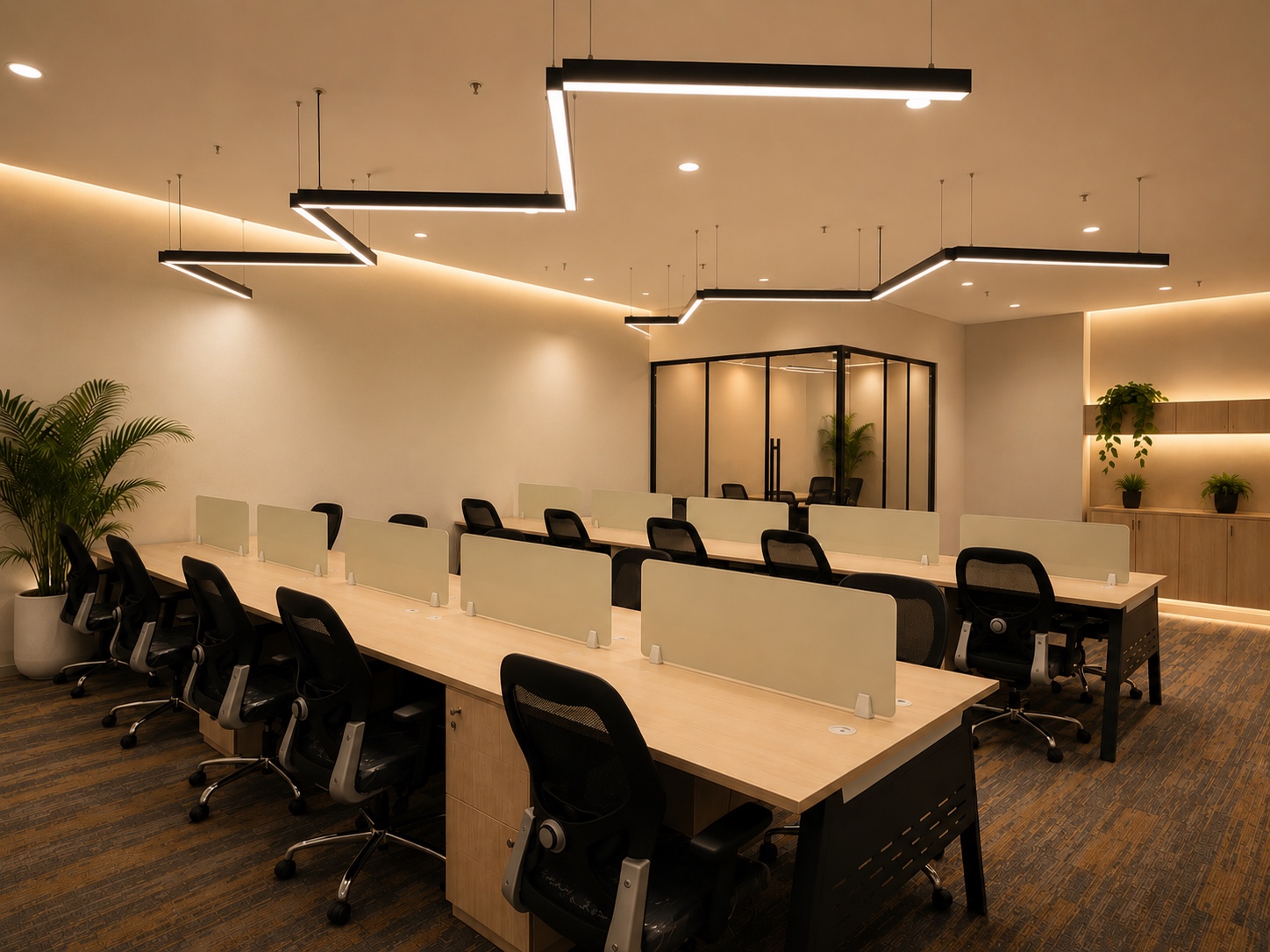
Founders ask this question at almost exactly the same three moments: when the kitchen-table team outgrows the kitchen table, when a client meeting goes badly because there was nowhere private to have it, and when the finance lead flags that the coworking bill has quietly become bigger than the first employee's salary. Each moment has a different right answer.
The private office versus coworking decision gets framed online as a lifestyle choice — exposed brick and communal kombucha versus a closed door and a nameplate. In practice it's a headcount and workflow problem with a fairly predictable answer at each stage, and most teams get it wrong not because they pick the wrong format outright, but because they pick the right format eighteen months too late or too early.
The real variable is headcount volatility, not headcount size
It's tempting to think the decision is purely about how many people you have. It isn't. A 12-person team with a fixed roadmap and no hiring planned for a year behaves completely differently, in real-estate terms, from a 12-person team that's about to close a funding round and could be 25 people by Q2. The second team should weight flexibility far more heavily than the first, even though the headcount is identical today.
This is why "how many of you are there" is the wrong opening question. The better one is: how confident are you in that number twelve months from now? Teams with high confidence — services businesses, agencies with a stable client roster, back-office functions — can commit to private space earlier than product teams riding a fundraising or hiring cycle.
Stage one: under 8 people, coworking almost always wins
Below roughly eight people, a private office is usually the wrong call, even for well-funded teams. The math is simple: a private suite has fixed costs that don't flex down if two hires slip to next quarter, and it carries an admin burden — furniture, internet contracts, pantry supplies, a receptionist relationship — that a small team has no spare capacity to manage. A hot-desk or dedicated-desk coworking membership solves the actual problem at this stage, which is having a credible place to work and occasionally bring a client, without becoming a part-time facilities job for whoever's least busy that week.
The one exception worth naming: teams handling sensitive client data or regulated work from day one — legal, fintech, healthcare-adjacent — sometimes need a lockable room even at four or five people, for compliance reasons rather than growth reasons. That's a private-office decision made for a different reason entirely, and it's worth separating clearly from the "we've grown enough" trigger.
Stage two: 8 to 20 people, the friction becomes visible
Somewhere in the 8-to-20 range, the cracks in a shared coworking setup stop being minor annoyances and start being operational costs. Three things tend to surface around the same time. First, meeting room scarcity: a 12-person team having three internal syncs and two client calls in a day will regularly lose the room-booking scramble to other members in the same facility, and that's before anyone's factored in interview slots for the hires you're trying to make. Second, confidentiality: strategy discussions, comp conversations, and investor updates happening at open desks or in glass rooms with thin walls create a low but constant risk that someone hears something they shouldn't. Third, and most underrated, identity: a team of 15 sitting at unassigned hot desks every day starts to feel less like a company and more like a collection of individuals who happen to badge into the same building — which quietly affects retention and culture at exactly the stage when culture is being set for good.
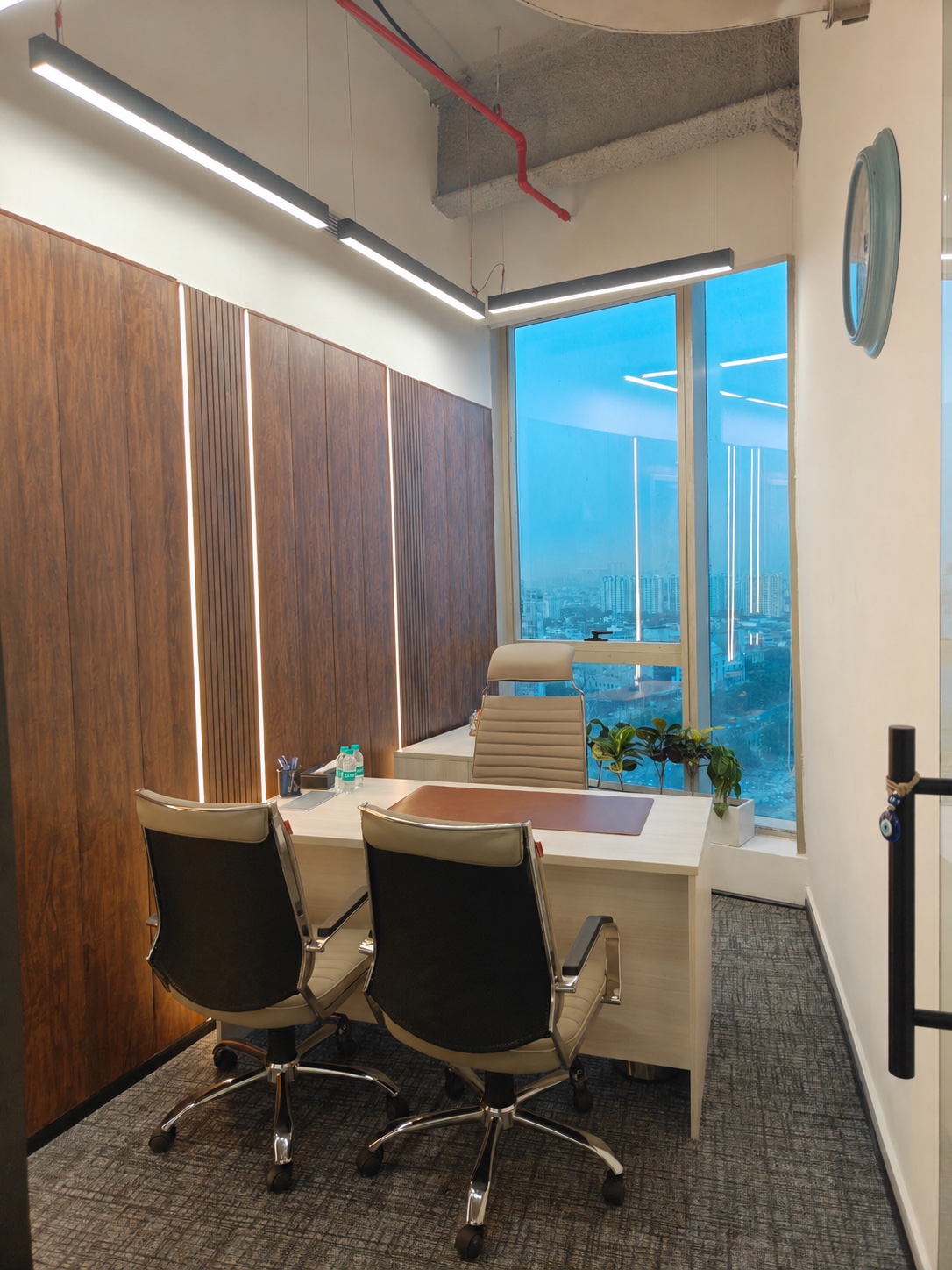
This is usually the point where a private office — either a lockable suite within a coworking-style managed building, or a small dedicated floor — starts paying for itself. Not because the team is "big enough" in some abstract sense, but because the cost of the friction (lost deals from a bad client meeting, a leaked comp number, a founder spending Friday afternoons room-hunting) now exceeds the cost of committing to a fixed space.
Signs you've crossed into private-office territory
- You've lost a meeting room booking to another company in the same coworking facility more than twice in a month.
- A client or candidate has overheard something confidential said at an open desk.
- Your team no longer sits together because hot desks fill up early and latecomers scatter across the floor.
- You're paying for five or more individual desk memberships — at that count, a small private suite is often cost-comparable, sometimes cheaper.
Stage three: 20 to 50+, the calculation flips again
Past roughly twenty people, the decision usually isn't "private office or coworking" anymore — it's "how much private office, and on what terms." Growing teams at this stage increasingly choose managed private offices over both raw coworking and a traditional bare-shell lease, because a managed setup gives them a fixed, predictable headcount capacity with none of the eighteen-month fit-out timeline or capex commitment of leasing and building a floor from scratch.
This is the segment where flexibility on the term — not the format — becomes the real negotiating point. A 35-person team expecting to be 55 by year-end doesn't want a five-year lease on a fixed floor plate; it wants a managed office provider who can either expand them within the building or move them to a larger unit in the same portfolio without a six-month gap. At Qaarya's AIPL Masterpiece and DLF Building 14 locations, this kind of internal expansion — moving a team from a 20-seat suite to a 40-seat one within the same building — is a normal, low-friction conversation precisely because it's planned for, not a special favor.
The hybrid path most fast-growing teams actually take
Very few teams move cleanly from coworking to private office in a single jump. The more common pattern — and arguably the smarter one — is a hybrid stretch: a small private suite for the core team (leadership, finance, anyone handling sensitive conversations) paired with flexible coworking or hot-desk capacity for the rest, especially for teams with distributed or hybrid attendance. This lets a company lock in the confidentiality and identity benefits of private space for the people who need it most, while keeping the flexible cost structure for headcount that's genuinely uncertain — new hires still on probation, contractors, or a sales team that's only in three days a week.
We've seen this pattern repeatedly across our M3M IFC building in Sector 66, where a number of tenants started with a 10-seat private cabin and kept a rolling coworking allocation for overflow, rather than either overcommitting to a 30-seat suite too early or staying fully flexible and hitting the friction points described above.
A practical framework: run these four checks before deciding
- Confidentiality audit. List every recurring conversation — comp reviews, investor updates, client contracts — that currently happens somewhere it shouldn't be overheard. If the list has three or more items, weight toward private.
- Room-booking friction. Track how many meetings got moved, shortened, or held in a suboptimal space over the last month due to availability. More than four is a signal.
- Headcount confidence, six and twelve months out. If your range at twelve months is tight (say, 22–26 people), private office terms become easier to size correctly. If it's wide (18–40), lean toward flexible or hybrid.
- Cost crossover. Add up current per-seat coworking spend, including any add-ons for meeting room credits or storage. Compare it directly to a managed private-office quote for the same headcount — the crossover point is often earlier than founders expect, especially once meeting-room overage fees are included.
What "managed" changes about this decision
A lot of the traditional downside of private offices — the fit-out timeline, the furniture procurement, the facilities headcount, the multi-year lease risk — disappears once the private office is managed rather than leased raw. That's the real shift in this market over the last few years: the choice used to be coworking's flexibility versus a private lease's rigidity. Now it's increasingly coworking's flexibility versus a managed private office that offers most of that same flexibility, just with a locked door and your own nameplate. That changes the calculation earlier for a lot of teams — sometimes even inside the 8-to-20 range, if confidentiality or brand presence matters enough to the business.
What each option actually costs once you add the line items nobody quotes upfront
Headline pricing is the least useful number in this decision. Coworking memberships are usually quoted per desk per month, but the real monthly spend includes meeting room overage once your free credits run out, printing and courier add-ons, parking (often uncapped and billed separately), and the soft cost of staff time spent managing bookings and disputes with facility staff during busy weeks. Teams that compare only the base membership price against a private-office quote are comparing an incomplete number to a complete one, and the coworking side almost always looks artificially cheaper as a result.
Private office quotes from a managed provider, by contrast, are usually closer to all-in — rent, furniture, internet, housekeeping, and often meeting room access bundled into a single per-seat figure. That bundling is exactly why a side-by-side comparison needs to normalize for it. Ask any coworking provider for a fully loaded monthly number based on your actual usage pattern over the last three months, not the rate card, before treating a comparison as final.
Questions worth asking any provider before you sign
- What happens if we need to add six seats in ninety days? A vague answer here is itself the answer — it means expansion isn't actually planned for.
- Is meeting room time metered, and what's the overage rate? This single line item is where coworking budgets quietly blow out.
- Who do we call at 8pm if the AC fails before a client visit the next morning? A real name and number, not a ticketing portal, is the answer that matters.
- Can we downsize without penalty if a hiring plan slips? Term flexibility matters as much in the downward direction as the upward one.
Why the decision deserves more time than teams usually give it
Founders will spend weeks evaluating a new hire and about twenty minutes evaluating where that hire will sit for the next two years. That asymmetry is understandable — office space feels like a solved problem compared to hiring — but the downstream cost of getting it wrong compounds in ways that are easy to underestimate. A team that outgrows its coworking setup and delays the move for six months doesn't just lose meeting rooms; it loses interview slots to competitors with better space, loses the ability to host a client dinner walkthrough that closes a deal, and absorbs a steady trickle of small frustrations that show up later as unplanned attrition.
Conversely, a team that commits to a private suite too early — before headcount confidence justifies it — ties up capital and flexibility that would have been better spent on the next two hires. Both mistakes are avoidable with the same discipline: revisit the four-check framework above every quarter, not just at the moment the current lease or membership is up for renewal. Office decisions made reactively, under deadline pressure from an expiring contract, are reliably worse than the same decision made three months ahead of need.
None of this replaces walking the actual space with your actual team size in mind. A framework tells you which way to lean; a site visit tells you whether the specific floor, the specific meeting room count, and the specific building actually fit how your team works day to day. But if you're staring at a coworking invoice wondering whether it's time, the checks above are a faster way to get an honest answer than gut feel alone.