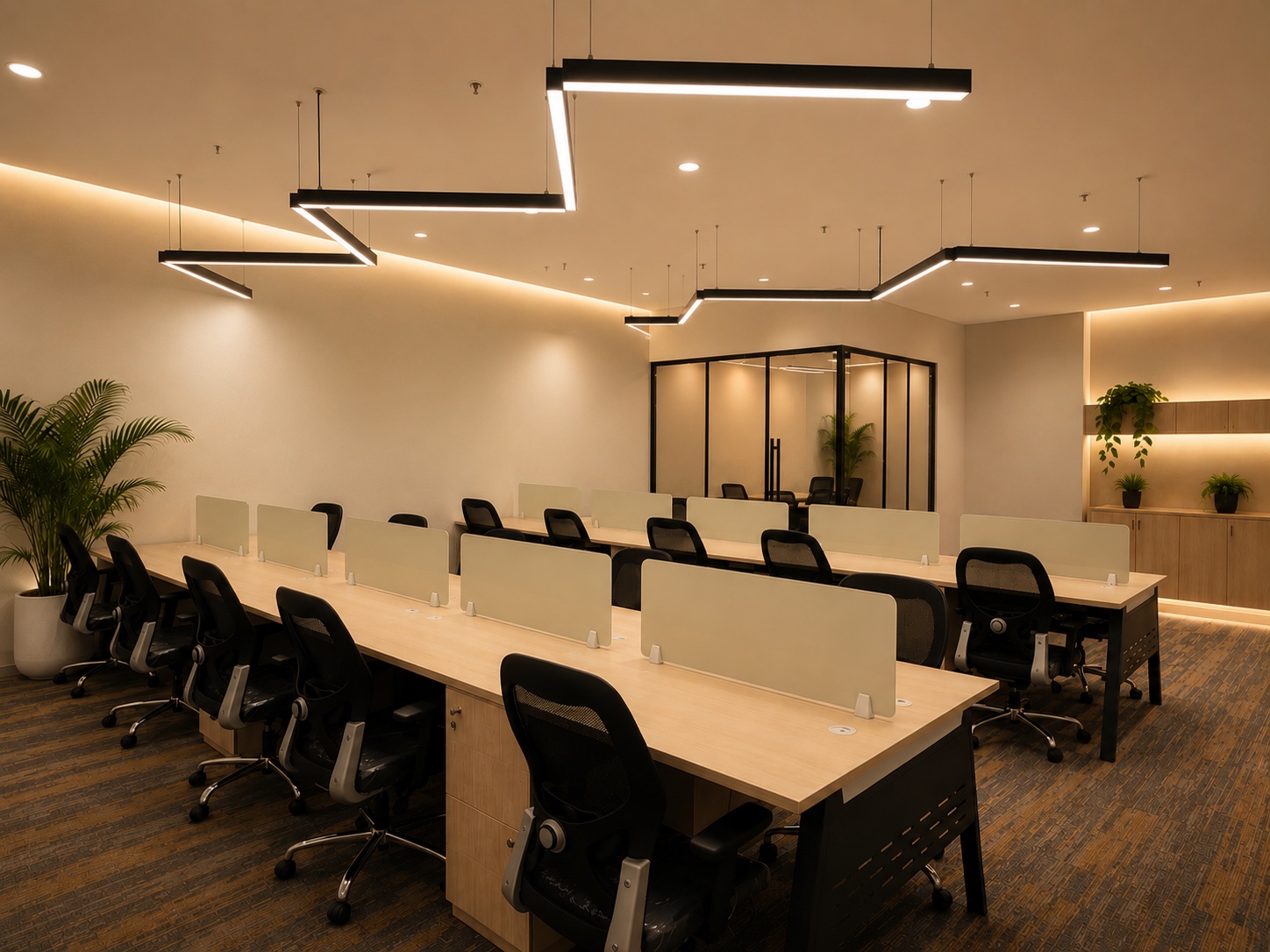
Premium Managed Offices

Key takeaways
- India had 2,117 GCCs across 3,728 units and 2.36 million employees at the end of FY26, generating about $98.4 billion in revenue (Nasscom-Zinnov).
- 506 Forbes Global 2000 companies now run a GCC in India, and the count of centers is up 32% since FY2021.
- The pitch has moved from cost savings to capability: engineering, AI, product and risk work that headquarters wants close to the best talent pool.
- GCCs were about 42% of India's office leasing in Q2 2026 (CBRE), which is why prime, expandable space is the scarce input.
- A first-time GCC usually does not need a long lease. It needs a private, secure, customizable office that can grow with each hiring wave.
- A growing share of new centers start as a Nano GCC: a small, focused team built around high-impact compact teams rather than headcount.
Ten years ago, a global company opening an India center was usually answering one question: how do we do this work for less? In 2026 the question has changed. The center is now where the product gets built, where the models get trained and where a growing share of the company's best engineers sit. The office that houses it is a strategic decision, not a facilities line item.
The scale is easy to state and hard to ignore. The Nasscom-Zinnov India GCC Landscape report puts India at 2,117 global capability centers operating across 3,728 units at the end of FY26, employing roughly 2.36 million people and generating about $98.4 billion in market revenue. The number of centers has grown 32% since FY2021. And 506 companies from the Forbes Global 2000 now run at least one GCC in the country.
If you are a CFO, COO or head of real estate at a company that is about to become the 2,118th, the useful question is not whether the trend is real. It is what the trend implies for the first office you pick.
What a GCC actually is, and what it is not
A global capability center, also called a global in-house center, is a unit that a multinational owns and operates in another country to perform work for the parent. It is not a vendor. It does not bill the parent per project. Its people are the company's own employees, working on the company's own roadmap, under the company's own security and compliance rules.
That ownership is the whole point. An outsourcing contract buys output. A GCC builds institutional knowledge, keeps intellectual property in-house and lets headquarters hire the same people, to the same standard, that it would hire at home. The trade-off is that the company must now do things a vendor used to do for it: recruit at scale, run payroll and compliance in a new jurisdiction, and provide a workplace.
Five forces pulling work into India
1. Talent depth, not just talent cost
Cost savings are still real, and industry estimates commonly put total cost per role well below home-market levels, with the gap widest at junior and mid levels. But the argument that now wins board approval is depth. India graduates engineers, data scientists and finance professionals at a scale few countries match, and the experienced layer, the people who have already built products at global companies, is deep in Delhi NCR, Bengaluru, Hyderabad, Pune and Chennai. A GCC is often the only way for a foreign company to hire 200 senior engineers in a single city within a year.
2. A mandate that has moved up the value chain
Early GCCs ran back-office processes. Current ones own product engineering, cybersecurity, analytics, AI and increasingly the strategy for a whole business line. Coverage of the 2026 Nasscom GCC Summit framed the story the same way: a shift from scale to ownership, with centers leading global mandates rather than executing handed-down tasks. When a center owns outcomes, leadership travels there, clients visit and the office becomes part of the brand.
3. Follow-the-sun delivery
An India team overlaps with Europe in the morning and with the US East Coast in the evening. That makes 24-hour engineering and support practical without night shifts for a single team. It also means the office has to be genuinely usable at unusual hours, with access, power and food that do not stop at 6 pm.
4. Policy that now competes for you
State governments are bidding for GCCs. Haryana notified its Global Capability Centres Policy in 2026 with capital and operating support for new centers, which we cover in detail in a later post. Whatever the exact numbers for your case, the direction is clear: governments want these centers and will negotiate.
5. A mature set of partners
Legal entity setup, employer-of-record services, hiring firms, build-operate-transfer providers and managed workspace operators all exist at scale. A decade ago a company opening an Indian center built each of these relationships from scratch. Now many can be rented, which shortens the path from board approval to first hires.

The real estate consequence: demand has outrun the comfortable supply
When thousands of centers expand at once, they compete for the same buildings. CBRE's Q2 2026 India office figures show GCCs at about 42% of national office absorption, a record, in a quarter when India leased roughly 24.6 million sq ft. In Delhi NCR, the same data shows flex operators taking 45% of 3.6 million sq ft of leasing, with flex take-up rising from 0.3 million sq ft in Q2 2025 to 1.6 million sq ft in Q2 2026. CBRE describes the emerging pattern as a “core plus flex” portfolio.
That pattern is telling. The largest and most sophisticated occupiers are not choosing between a long lease and no office. They are keeping a stable core and layering flexible, serviced space around it. For a company at the start of its India journey there is no core yet, so the logic applies more strongly: start flexible, and let the shape of the permanent office emerge from real headcount.
What first-time GCCs tend to get wrong about space
- They sign for the end state. A lease sized for 300 seats is a bet on a hiring plan that will change twice in the first year.
- They underestimate fit-out time. A bare-shell floor needs design, approvals, vendors and a handover. Our later post on the first 90 days of a GCC shows how that sequence crowds out hiring.
- They treat the first office as temporary. The first 30 hires set culture, security habits and the impression every visiting executive carries home.
- They ignore expansion rights. The question is not how many seats you need today, but whether the building can give you the next 40 without a move.
What a new GCC should ask of its first office
| Requirement | Why it matters | What to check |
|---|---|---|
| Private, lockable space | Client and IP confidentiality | Dedicated entrance or floor access, no shared common desks |
| Fast occupancy | Hiring starts before fit-out finishes | Move-in in days or weeks, not quarters |
| Room to grow | Headcount rarely follows the plan | Written expansion path, ideally in the same building |
| Customization | Brand, layout, team zones | Branding, partitions, IT cabling without a full fit-out |
| Prime address | Hiring, client visits, leadership travel | Metro, highway and airport access; business-district reputation |
| All-in pricing | Predictable cost for finance | One monthly fee covering power, housekeeping, internet, meeting credits |

Where managed offices fit
A managed, serviced private office is built for precisely this stage. At QAARYA's locations, M3M IFC on Golf Course Extension Road, DLF Building 14 in Cyber City and AIPL Masterpiece on Golf Course Road, a team can take fit-out-ready private cabins and move in within days rather than months. Pricing is one all-inclusive fee with only GST on top. The standard term is a 12-month minimum, after which seats can be scaled up or down as the team changes. Members get 24x7 access, which matters for a center that works across time zones.
It is not the right answer for every GCC. A center that will certainly reach 1,000 people in 24 months should be planning a campus, and our post on private office vs coworking covers where the line sits for smaller teams. But for the very large group of companies that will start at 20 to 100 people and grow unpredictably, a managed private office removes the two biggest early risks: spending hiring time on construction, and locking in a footprint before the plan is real.
The rise of the Nano GCC and high-impact compact teams
The headline numbers describe scale, but the way many companies now enter India is small. We use the term Nano GCC for a deliberately compact center, often 10 to 50 people, with a narrow mandate such as one product line, one analytics function or one platform team. It is our working label, not an official Nasscom or Zinnov category, but it describes a pattern that is easy to recognise: prove the model with a small group before committing to a campus.
What makes a Nano GCC work is high-impact compact teams: a small number of senior people who own outcomes end to end, rather than a large pool of junior capacity. Five strong engineers with clear ownership often beat twenty people waiting for direction. The Nano GCC is the container; the high-impact compact team is how the work gets done.
This matters for real estate because a Nano GCC has almost opposite needs to a campus. It needs a private, secure space for 10 to 50 people, available in days, with a clear path to grow if the team earns it. That is why the rest of this series keeps returning to the first office.
Four myths about the move to India
Myth 1: “It is all about cost.”
Cost still matters, and no finance team will approve a center that costs more than the alternative. But if cost were the whole story, centers would cluster in the cheapest city. They do not. They cluster where senior, specialised people are available, which is why the same cities keep winning. The cheapest seat is rarely the best seat.
Myth 2: “A GCC is a big-company move.”
The 506 Forbes Global 2000 firms in the Nasscom-Zinnov count are the headline, but the report series also tracks a mid-market segment of smaller centers. A center of 30 to 80 people is a normal, viable shape. This matters for real estate, because most of the first-office decisions in the market are made at that scale, not at the campus scale.
Myth 3: “Once approved, it runs itself.”
A GCC is an operating business inside a business. It needs a leader, a hiring engine, compliance, facilities and a relationship with headquarters. The companies that struggle are usually the ones that treated the approval as the finish line.
Myth 4: “The office is a detail to sort out later.”
The office is the first thing every new hire, every visiting executive and every candidate sees. It is also one of the few elements of a GCC launch that you can shorten by choosing differently. “Later” is how it ends up on the critical path.
What different functions need from the same office
GCCs are no longer one thing, so a single office template does not fit. A useful way to think about the space is by function.
- Engineering and product: quiet focus areas, whiteboard-friendly rooms, strong connectivity, a pantry that keeps people on site, and flexible hours.
- Finance, risk and operations: controlled access, clean-desk discipline, private rooms for sensitive discussions and predictable shift patterns.
- Analytics and AI: high-bandwidth connectivity, secure data handling and rooms for working sessions with stakeholders on video.
- Leadership and programme teams: client-ready meeting rooms, space for visiting executives and a reception that makes a good impression.
A managed private office with team zones can serve several of these under one roof, which is one reason a first-year center does not need a bespoke building.
A practical way to use this data
- Decide your first-year headcount range, not a number. A range of 25 to 75 is more honest than 50, and it drives a different space strategy.
- Separate the office decision from the entity decision. The legal entity may take weeks; the office should not wait for it.
- Choose a city for talent first, then a district for access. We unpack the Gurugram case in the next post of this series.
- Pick a space that can absorb your upside case. If the high-end hiring plan lands, where do the extra people sit?
If you are weighing Delhi NCR, you can see the private offices and meeting spaces QAARYA runs in Gurugram, or review the workspace solutions available for teams that need to start small and expand quickly.
Planning a global capability center in Gurugram? See QAARYA's private office solutions for GCCs, or talk to the team on +91 96504 98482.
Frequently asked questions
What is a global capability center (GCC)?
A global capability center is a captive unit that a multinational sets up in another country, most often India, to run engineering, technology, analytics, finance, HR or other functions for the parent company. It is owned by the parent, not outsourced to a vendor.
How many GCCs are there in India?
According to the Nasscom-Zinnov India GCC Landscape report for FY26, India has 2,117 GCCs operating across 3,728 units and employing about 2.36 million people.
Why are companies moving GCCs to India?
Companies move GCCs to India for the depth of engineering and AI talent, lower total cost per role than most home markets, time-zone coverage, and a mature ecosystem of real estate, legal and hiring partners. Most new centers are now justified by capability and speed, not only by cost.
What kind of office does a new GCC need in India?
A new GCC typically needs a private, access-controlled office that can be occupied within weeks and expanded as headcount grows. Managed private offices fit this need better than a long lease with a bare-shell fit-out.
Is Gurugram a good city for a GCC?
Yes. Gurugram offers a large pool of experienced talent, established business districts such as Cyber City and Golf Course Extension Road, and Haryana's GCC Policy 2026 incentives. It is one of the main GCC destinations in Delhi NCR.
What is a Nano GCC?
A Nano GCC is a deliberately small global capability center, typically starting with roughly 10 to 50 people, with a narrow mandate and senior, high-impact compact teams that prove value quickly before the center scales. It is a way of describing a lean start, not an official Nasscom or Zinnov category.