Premium Managed Offices
Key takeaways
- The main acoustic problem in an open office is intelligible speech, not loudness. Words you can follow pull attention in a way that a steady hum does not.
- Research by Haapakangas and colleagues found that speech intelligibility predicts both disturbance and performance on verbal memory tasks. ISO 3382-3 builds this into the “distraction distance” measure for open-plan offices.
- Open plans do not reliably increase collaboration: in Bernstein and Turban’s 2018 Harvard study, face-to-face interaction fell by roughly 70% after two companies moved to open offices.
- Fix acoustics in cost order: etiquette and zoning first, then phone booths and quiet rooms, then soft surfaces, then sound masking.
- A useful rule: one phone booth or small quiet room for every 8 to 12 open desks, so calls leave the floor.
- For deep, confidential or call-heavy work, a private cabin with a door beats any treatment you can add to an open floor.
Ask people what they dislike about their office and noise is near the top of almost every list. Ask facilities teams what they have done about it and the answer is usually a few felt panels and a request to “keep it down.” Neither touches the real problem. The trouble with an open floor is not that it is loud. It is that you can understand what everyone around you is saying.
This post explains why speech, not volume, breaks concentration, what the research actually shows, which fixes work, ranked from cheapest to most expensive, and what to listen for when you tour an office. If your team does reading, writing, analysis or calls for a living, this is a productivity question, not a comfort one.
What the research says about open plans
The open-plan office was sold on collaboration: take down the walls and people will talk more. The best-known test of that idea found the opposite.
In a study published in 2018 in Philosophical Transactions of the Royal Society B, Ethan Bernstein and Stephen Turban of Harvard Business School used wearable sensors and message logs to track employees at two large companies before and after each moved to an open-plan layout. Face-to-face interaction fell by roughly 70% in both cases, while email and instant messaging rose. At the first company, executives also reported that productivity, as measured by their own internal metrics, declined after the redesign. The samples were modest, and two companies are not the whole economy. But the direction is hard to ignore: removing walls did not make people talk more. It made them retreat into headphones and screens.
The reason is not mysterious. When everyone can hear everyone, people protect themselves. They avoid conversations that others will overhear, take sensitive discussions elsewhere and use messages instead of a quick word.
The real problem: speech you can understand
Volume alone is a weak predictor of distraction. A steady air-conditioning hum at a moderate level is barely noticed after a few minutes. A colleague two desks away explaining a client issue at a lower level can wreck an hour of writing. The difference is meaning.
Acoustic researchers describe this with the Speech Transmission Index (STI), a measure of how intelligible speech is, from 0 (unintelligible) to 1 (perfectly clear). Work by Annu Haapakangas and colleagues in Finland, summarized in her 2017 doctoral thesis at the University of Turku, found that speech intelligibility predicts both how disturbed people feel and how well they perform on tasks that rely on verbal short-term and working memory: reading, writing, mental arithmetic, the core of most office work. An earlier laboratory study by the same group, published in Indoor Air in 2009, found that disturbance rose clearly with intelligibility, even where measured performance differences were smaller, and concluded that reducing intelligibility through acoustic design benefits comfort and work.
The international standard for open-plan acoustics, ISO 3382-3 (revised in 2022), builds on this. One of its key measures is the “distraction distance”: the distance from a talker at which STI falls below 0.50, the point at which speech stops being easily understood. A well-designed open office has a short distraction distance. A badly designed one lets a conversation stay intelligible across half the floor.
Why this changes how you fix noise
- Quieter is not the goal. A very quiet open floor can make speech more intelligible, because there is nothing to cover it.
- Distance and barriers matter. Every meter between a talker and a listener, and every absorbing or blocking surface between them, reduces intelligibility.
- Calls are the worst offenders. You hear one side of a phone conversation, which the brain finds especially hard to ignore.
- Focus work and speech must be separated. No treatment makes an open desk next to a sales team suitable for deep work.
Fixes ranked by cost
Most acoustic advice starts with products. Start with behavior and layout instead; they are cheaper and often do more. The table below ranks the main fixes from cheapest to most expensive. Costs are relative and illustrative, not quotes.
| Rank | Fix | Relative cost | What it solves | Limits |
|---|---|---|---|---|
| 1 | Etiquette rules | Near zero | Calls and loud talk at desks; speakerphone use | Needs leaders to model it; erodes without reminders |
| 2 | Zoning the floor | Low | Separates focus desks from social, sales and entry areas | Needs enough floor area to create real distance |
| 3 | Phone booths | Low to moderate | Moves one-person calls and video meetings off the floor | Needs enough booths, ventilation and light to be used |
| 4 | Quiet rooms and small meeting rooms | Moderate | Gives deep work and two-person talks a door | Takes floor area; needs booking discipline |
| 5 | Soft and absorbent surfaces | Moderate | Reduces reflections from ceilings, glass and hard floors | Does little for a talker two desks away without barriers |
| 6 | Sound masking | Moderate to high | Shortens the distance at which speech is intelligible | Needs professional tuning; disliked if set too loud |
| 7 | Private cabins | Highest per seat | Full control of speech for focus, calls and confidential work | Less spontaneous contact unless paired with shared space |
1. Etiquette: the free fix nobody enforces
Write three rules and have leaders follow them visibly. No calls at desks. No speakerphone anywhere on the open floor. Conversations longer than two minutes move to a room or the lounge. That alone removes the most intelligible and most irritating noise.
2. Zoning: put distance between talkers and thinkers
Map who talks and who concentrates. Sales, client service and team leads on calls sit together near the entrance and the pantry. Analysts, writers, engineers and finance sit at the far end, with storage, plants or a meeting room between them. Distance is the cheapest acoustic treatment there is.
3 and 4. Booths and quiet rooms: give speech somewhere to go
A good rule of thumb is one phone booth or small quiet room for every 8 to 12 open desks, and more for call-heavy teams. Hybrid work has made this more urgent, not less: a day in the office now often includes several video calls. If there is nowhere to take them, they happen at the desk. Our post on right-sizing an office for hybrid work covers how to trade surplus desks for these rooms.
5 and 6. Surfaces and masking: treat the room
Glass, concrete and hard floors reflect sound and extend how far speech carries. Acoustic ceiling tiles, carpet, upholstered furniture and wall panels absorb it. Sound masking adds a steady, engineered background sound so that distant words blur. Both help, but neither is a substitute for layout. Absorption without distance or barriers still leaves your neighbor’s call intelligible.
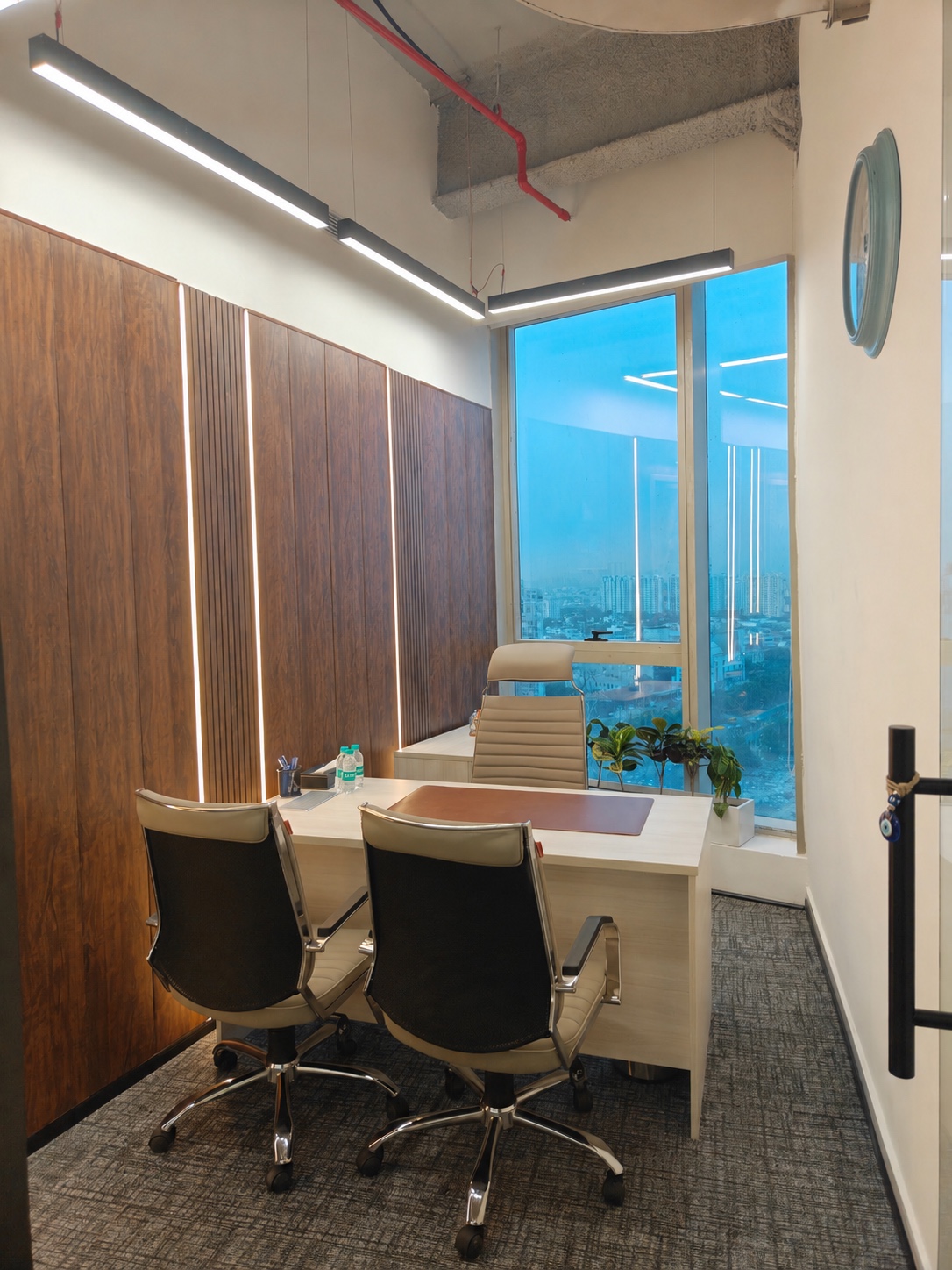
Why private cabins matter for focus work
Every fix above makes an open floor better. None makes it private. For a large share of knowledge work, that distinction matters.
Consider who on a typical team needs real acoustic control: the finance lead working through a reconciliation, the founder on a call with an investor, the HR manager in a difficult conversation, the analyst writing a report that will go to a board. Each needs either silence or confidentiality, and often both. A cabin with a door delivers that with no tuning, no etiquette campaign and no reliance on the people at the next desk.
The best layouts are not either-or. They combine private cabins for focused and sensitive work with shared lounges, meeting rooms and pantries for the conversation that open plans were meant to encourage. People choose the setting that fits the task, instead of fighting the setting they were assigned. This is one of the clearest dividing lines between an ordinary flexible office and a genuinely premium managed office.
The cost of noise, in plain numbers
Noise feels like a soft issue until you put a number on it. Take a team of 20 knowledge workers. Suppose noise and interruptions cost each of them just 30 minutes of effective focus a day, a deliberately conservative illustration rather than a measured figure. That is 10 hours a day across the team, or roughly 200 hours a month: more than a full-time employee’s working month, lost to overheard conversations.
Against that, compare the cost of the fixes. Etiquette and zoning are nearly free. A handful of phone booths or quiet rooms is a one-time cost or a modest increase in a managed office fee. Moving focus-heavy roles into private cabins costs more per seat than open desks, but the comparison is against lost hours, mistakes in detailed work and the people who quietly leave for a calmer office. Acoustics belongs in the same budget conversation as air quality and lighting: an input to output, not a decorative upgrade.
What to listen for on an office tour
Most people tour offices with their eyes. Tour with your ears too, and do it on a weekday afternoon when the floor is busy.
- Stand at a typical desk and listen for words. Can you follow a conversation three or four desks away? If yes, the distraction distance is too long for focus work.
- Find the phone booths. Count them against the number of desks. Are they occupied, ventilated and lit, or used as storage?
- Test a closed meeting room. Have someone speak inside at normal volume while you stand outside. You should hear voices, not sentences.
- Check the cabin walls. Do partitions run up to the slab, or stop at a false ceiling with open space above?
- Look at the surfaces. All glass and hard floor with no ceiling treatment usually means speech carries.
- Listen to the building systems. Is the air conditioning a steady, low background, or does it rattle and cycle on and off?
- Ask what the operator does about noise. Are there house rules for calls, quiet zones, or a way to report a problem?
In Gurugram, it is worth running the same test across different buildings and corridors. QAARYA’s private offices at M3M IFC on Golf Course Extension Road, DLF Building 14 in Cyber City and AIPL Masterpiece on Golf Course Road each pair enclosed cabins with shared lounges and meeting rooms, so you can hear the difference between the two kinds of space in one visit. On specifics such as cabin sizes and availability, ask during a tour.
The bottom line
Noise is not a volume problem. It is a speech problem, and the research is consistent that intelligible speech is what erodes focus and comfort. Fix it in cost order: rules and zoning first, then rooms for calls, then surfaces and masking. For the work that matters most, give people a door. An office that gets acoustics right will not sound silent. It will sound like a low, steady murmur in which nobody can quite make out what anyone else is saying, and everyone can get on with their own work.
Looking for an office where your team can actually concentrate? See QAARYA’s private office solutions in Gurugram, or talk to the team on +91 96504 98482.
Frequently asked questions
Why is open-plan office noise so distracting?
Open-plan noise is distracting mainly because it contains speech that people can understand. The brain automatically processes intelligible words, which competes with reading, writing and calculation. Research on office acoustics links higher speech intelligibility to greater disturbance and weaker performance on verbal memory tasks.
Do open-plan offices improve collaboration?
Not reliably. A 2018 study by Ethan Bernstein and Stephen Turban of Harvard Business School tracked employees at two companies that moved to open offices and found that face-to-face interaction fell by roughly 70%, while email and messaging increased.
What is the cheapest way to reduce office noise?
The cheapest fixes are behavioral and spatial: agree call and meeting etiquette, move calls and video meetings off the open floor, and zone the office so quiet work sits away from social areas and entrances. These cost little and often solve more than new furniture.
What is sound masking in an office?
Sound masking adds a low, steady, engineered background sound through ceiling speakers so that distant speech becomes harder to understand. It reduces the distance at which conversations are intelligible but works best alongside absorption and good layout, and needs professional tuning.
How many phone booths does an office need?
A practical rule of thumb is one phone booth or small quiet room for every 8 to 12 open desks, and more for call-heavy teams such as sales or client services. The goal is that nobody needs to take a call at their desk.
Are private cabins better than open plan for focus?
For focused, confidential or call-heavy work, a private cabin with a closed door is the most reliable way to control speech noise. Open areas still suit collaboration and social work, so many teams combine private cabins with shared meeting and lounge spaces.