Premium Managed Offices
Key takeaways
- Size a hybrid office for the peak day, not for headcount and not for the average. CBRE’s 2025 Americas survey found 73% of organizations at capacity on peak days but only 34% on average days.
- Indian employers want people in more often than Western ones: JLL’s Future of Work Survey 2024 found 56% of Indian organizations require five days in the office, while the average US firm requires about 2.87 days (Flex Index, 2025).
- A practical rule: three anchor days a week usually supports a desk-sharing ratio of about 1.2 to 1.4 people per desk; a five-day policy supports almost none.
- Hybrid teams need fewer desks but more meeting rooms, phone booths and collaboration space, because the days people come in are the days they meet.
- Measure for four to six weeks before you cut seats: badge or booking data, daily peaks, and the share of people present on anchor days.
- Flexible managed space lets you change seat count at review points without a new lease, which matters more when the policy itself is still moving.
Most hybrid offices are the wrong size. Some were leased for the full headcount and sit half empty from Wednesday to Friday. Others were cut to the average and leave people hunting for a seat every Tuesday. Both mistakes come from the same habit: sizing an office on a single number that does not describe how people actually use it. The fix is to size for the peak day, set a deliberate desk-sharing ratio and put the space you save into rooms where people meet.
This post sets out how to measure real utilization, how to choose a seat ratio for your attendance policy, why Indian employers are asking for more office days than their Western peers, and how to keep the seat count adjustable while the policy is still settling.
Headcount is the wrong number to plan with
Headcount tells you how many people could come in. It does not tell you how many will, or when. In a hybrid team, the gap between the two is the biggest cost in your real estate budget.
The average is not much better. CBRE’s 2025 Americas Office Occupier Sentiment Survey found that 73% of organizations say their offices are at capacity on peak days, but only 34% say the same about an average day. Two-thirds report average utilization below 60%. In other words, the same office is crowded and empty in the same week. An office sized to the average fails on the busy days; an office sized to headcount wastes money on the quiet ones.
Attendance data from the US shows the same shape. Kastle Systems’ Back to Work Barometer, which tracks badge swipes in ten large US cities, put the weekly average at around 56% in late October 2026, with the busiest day of the week close to 67%. The spread between the peak and the average is the space a hybrid office has to plan around.
How to measure real utilization
You cannot right-size what you have not measured. Four to six weeks of daily data is enough to make a decision; a single snapshot week is not, because holidays, client visits and launches distort it.
The four numbers to collect
- Daily attendance: people present each day, from badge, Wi-Fi or desk-booking data. Surveys of intended attendance tend to overstate it.
- Peak-day attendance: the highest daily count in a normal week, and the highest in the whole period. The first sets your seats; the second sets your buffer.
- Anchor-day concentration: the share of the team present on the days the company has asked everyone in. If it is above 85%, your anchor days are working and your peak is predictable.
- Meeting-room load: booked hours and how often people cannot find a room. This is usually the first thing to break when attendance rises.
Two cautions. First, policy is not behavior: CBRE found that US employers expected 3.2 office days a week in 2025 while employees averaged 2.9. Measure what happens, not what the handbook says. Second, measure by team, not just company-wide. A sales team in on Monday and an engineering team in on Thursday can share the same desks; two teams both in on Tuesday cannot.
Why Indian firms want people in more than the West
If you are planning an office in India, do not import a US or European seat ratio without checking it against local behavior. Indian employers ask for more office time.
JLL’s Future of Work Survey 2024 found that 90% of organizations in India require at least three office days a week, and 56% require a full five-day week. JLL describes India as one of the strongest advocates for in-office work globally. CBRE’s 2025 India Office Occupier Survey points the same way: 94% of occupiers prefer at least three office days a week, and 55% report average office utilization above 75%.
The US picture is looser. The Flex Index, which tracks policies at more than 9,000 US firms, reported in 2025 that the average US firm requires about 2.87 office days a week, and that 67% of US companies with fewer than 500 employees remain fully flexible.
The reasons are partly cultural and partly structural. Many Indian offices run large delivery and client-service teams that rely on in-person supervision, mentoring and quick escalation. Younger workforces often lack a good home setup. And many firms simply see the office as where the work happens. Whatever the cause, the planning consequence is clear: a Gurugram team on a four- or five-day policy cannot share desks aggressively, and its peak is close to its headcount.
A seat-ratio framework for hybrid teams
The table below links attendance policy to a starting desk-sharing ratio and to the support space that policy needs. The ratios are illustrative starting points, not industry standards; your own peak-day data should override them.
| Attendance pattern | Typical peak-day presence | Starting desk-sharing ratio | Desks per 50 people | Support space priority |
|---|---|---|---|---|
| Five days in office | 90% to 100% | 1.0 : 1 (no sharing) | 50 | Focus space, phone booths |
| Four days, fixed | 85% to 95% | 1.0 to 1.1 : 1 | 45 to 50 | Phone booths, small rooms |
| Three anchor days | 70% to 85% on anchor days | 1.2 to 1.4 : 1 | 36 to 42 | Meeting rooms, team tables |
| Two anchor days | 55% to 75% on anchor days | 1.4 to 1.7 : 1 | 30 to 36 | Collaboration space, large rooms |
| Employee choice, no anchor days | 40% to 60%, unpredictable | 1.5 to 2.0 : 1, plus booking | 25 to 33 | Bookable desks, on-demand rooms |
For context, CBRE’s 2025 Americas survey found that more than half of companies using unassigned seating run people-to-seat ratios below 1.5 to 1, while 73% expect ratios above 1.5 to 1 by 2027. Indian teams, with higher attendance, will usually sit at the lower end of the table.
Rules that make the ratio work
- Add a buffer of 5% to 10% above the measured peak, so a client visit or new joiner does not break the day.
- Stagger anchor days by team. Two teams on different anchor days can share one pool of desks; staggering is how you earn a higher ratio.
- Keep some desks assigned. Leadership, finance close teams and anyone in five days should not be in the shared pool.
- Review quarterly. If the peak day regularly exceeds 90% of seats, the ratio is too aggressive.
For the space side of the calculation, our guide to office space per employee in India converts seat counts into square feet.
What hybrid teams need more of, and less of
People do not commute to answer email. On office days they meet, review work together, onboard new joiners and see clients. The mix of space should follow.
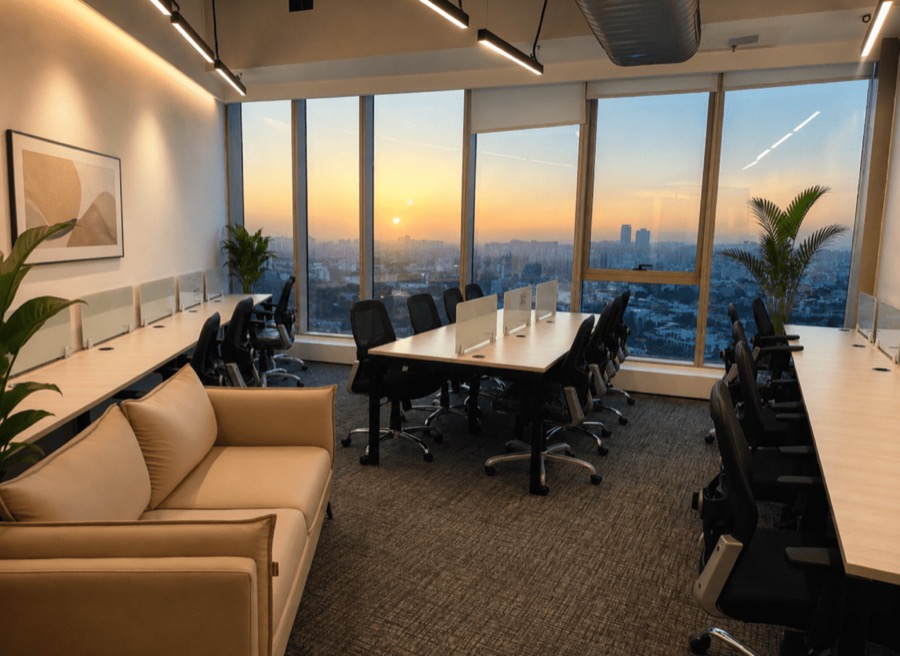
More of
- Meeting rooms, especially small ones. Two- to four-person rooms carry most hybrid meetings, which usually include remote colleagues on video.
- Phone booths. One person on a call at an open desk disrupts six others.
- Team tables and project zones where a squad can sit together on its anchor day.
- Lounge and informal space for the conversations that justify the commute.
Less of
- Assigned desks for people who are in two or three days a week.
- Large, rarely used rooms that sit empty between quarterly reviews.
- Storage and filing space that a paperless, laptop-based team no longer needs.
The demand for on-demand rooms is visible in occupier data. In CBRE’s 2025 Americas survey, 39% of respondents said offering on-demand meeting and collaboration space was a reason to use flexible space, and 42% cited uncertain demand.
The cost of getting it wrong
The ROI of right-sizing is simple arithmetic. Take a 100-person team on three anchor days. If it leases 100 desks and its measured peak is 78, it is paying for 22 desks that are never used, plus the area, power, cleaning and fit-out around them, every month for the life of the lease. At a ratio of 1.25 to 1 it needs about 80 desks, which covers the peak with a small buffer.
Some of that saving should be reinvested, not banked. Converting the space of eight or ten desks into two small meeting rooms and a few phone booths usually raises the quality of the office day far more than it costs. The goal is not the smallest office. It is the office where every seat and room does work on the busy days.
Under-sizing has a cost too, though it is harder to see. If people regularly arrive on an anchor day and cannot find a seat or a room, they stop coming in, and the policy fails quietly. CBRE’s India survey suggests most Indian occupiers already run high utilization, so the risk in India is often too few seats, not too many.
Keep the seat count adjustable
The hardest part of hybrid planning is that the inputs keep moving. Attendance policies tighten and loosen, teams grow and shrink, and a ratio that works this quarter may not work next year. A long lease fixes the footprint while everything else changes.
That is the case for flexible managed space. Instead of committing to a fixed number of desks for years, a team can add or release seats at review points as the data comes in, and use on-demand conference rooms for the occasional large meeting rather than owning one. Larger organizations can combine the two, holding a leased core and keeping a flexible layer around it, which we cover in our post on core plus flex office strategy.
In Gurugram, QAARYA’s private offices at M3M IFC on Golf Course Extension Road, DLF Building 14 in Cyber City and AIPL Masterpiece on Golf Course Road come with customisable layouts, so a hybrid team can shape its mix of desks, rooms and collaboration space rather than inheriting someone else’s plan. If you are still deciding between a private office and shared space, our comparison of private office vs coworking sets out when each makes sense. Scaling terms and notice periods are worth asking about during a tour.
A four-step plan for the next quarter
- Measure. Collect four to six weeks of daily attendance and meeting-room data by team.
- Choose a ratio. Use the framework above, then test it against your measured peak plus a 5% to 10% buffer.
- Reallocate. Turn surplus desks into small meeting rooms, phone booths and team tables.
- Set a review date. Revisit the ratio each quarter, and keep enough flexibility in your space to act on what you learn.
Hybrid work did not make offices less important. It made them harder to size. Measure the peak, design for the days people actually come in, and keep the footprint flexible enough to follow the data. To see how that looks in practice, explore QAARYA’s managed office solutions.
Right-sizing a hybrid team in Gurugram? See QAARYA’s managed office solutions, or talk to the team on +91 96504 98482.
Frequently asked questions
How do you calculate office utilization for a hybrid team?
Divide the number of people present on a given day by the number of seats, and track it daily for at least four to six weeks. Look at both the average and the peak day, because the peak sets the minimum number of seats you need. Badge, Wi-Fi or booking data is more reliable than surveys.
What is a good desk-sharing ratio for hybrid work?
For teams with three anchor days a week, a desk-sharing ratio of about 1.2 to 1.4 people per desk is a reasonable starting point. CBRE’s 2025 Americas survey found that more than half of seat-sharing companies run ratios below 1.5 to 1. Teams that are in the office four or five days should not share desks at all.
Should a hybrid office be sized for average or peak attendance?
A hybrid office should be sized for peak attendance, usually the busiest anchor day, plus a small buffer. Sizing to the average leaves people without a seat on the days the whole team is in. Sizing to total headcount pays for desks that are empty most of the week.
Are Indian companies requiring more office days than Western companies?
Yes. JLL’s Future of Work Survey 2024 found that 56% of Indian organizations require a full five-day office week and 90% require at least three days. By comparison, the Flex Index reported in 2025 that the average US firm requires about 2.87 office days a week.
What spaces do hybrid teams need more of?
Hybrid teams need more meeting rooms, small rooms and phone booths for video calls, and open collaboration space, because office days are mostly used for meeting and working together. They need fewer assigned desks. Quiet focus space still matters, but much heads-down work moves to home days.
How can a company change its seat count without signing a new lease?
A flexible managed office lets a company add or release seats at agreed review points instead of committing to a fixed footprint for years. This suits hybrid teams whose attendance policy and headcount are still changing. Confirm notice periods and scaling terms in writing before signing.