Premium Managed Offices

Key takeaways
- A Nano GCC (roughly 10 to 50 people, one mandate) is built to prove value fast; a full-scale GCC is built to run many functions efficiently for years.
- Vendor guides put an EOR start at 1 to 2 weeks and a wholly owned captive at 16 to 24 weeks or more, so speed favors starting small.
- Most of India’s centers are not yet at the top of the maturity curve: Zinnov’s 2026 framework puts 13% at Outpost, 43% at Satellite and only 5% at Transformation Hub.
- The biggest cost difference at small scale is not rent; it is fit-out capex and empty seats, which a Nano GCC avoids in a managed private office.
- Scale when the triggers line up: a proven mandate, a second function asked for by headquarters, a stable leader bench, and a team that has outgrown its space.
- Rule of thumb: do not plan a full-scale center until the first high-impact compact team has hit its targets for at least two consecutive quarters.
The usual framing is that a Nano GCC is a smaller, cheaper version of a real GCC: a starter kit you outgrow. That framing leads companies to make two expensive mistakes. Some build a full-scale center before they have proved anything, and carry empty floors for years. Others keep a Nano GCC small long after it has earned the right to grow, and lose the talent and mandate that would have justified scale.
A Nano GCC and a full-scale GCC are different designs, built for different questions. One asks “can India do this work for us?” The other asks “how do we run this work at scale, efficiently, for a decade?” This post compares them on the six dimensions that matter, then sets out the triggers that tell you it is time to move from one to the other.
The short definitions
A Nano GCC is a small, focused capability center in India doing real work for a parent abroad, typically starting with roughly 10 to 50 people, one narrow mandate and senior high-impact compact teams. Our explainer on what a Nano GCC is covers the definition in detail.
A full-scale GCC runs several functions, often with hundreds or thousands of people, layered leadership, its own governance, and a long-term real estate footprint. The Nasscom-Zinnov India GCC Landscape Report 2026 counts 2,117 GCCs across 3,728 units employing about 2.36 million people, so “full-scale” covers a wide range.
Zinnov’s maturity framework is a useful reminder of where most centers actually sit. On its 2026 landscape page, 13% of India’s GCCs are classed as Outpost, 43% as Satellite, 39% as Portfolio Hub and only 5% as Transformation Hub. Scale is a journey most centers are still on, not a starting point.
Nano GCC vs full-scale GCC: the comparison
| Dimension | Nano GCC | Full-scale GCC |
|---|---|---|
| Cost | Small total budget, mostly opex; no fit-out capex; higher cost per seat is acceptable | Large budget with capex; lower cost per seat over a long horizon |
| Speed to launch | Weeks, often via EOR or a managed partner | Months, typically via a captive entity or BOT |
| Governance | One leader reporting to one sponsor at headquarters | Center head, function heads, a local board and formal steering |
| Talent | Senior specialists; every hire is visible | Pyramid of senior, mid and junior; campus hiring pipeline |
| Office model | Managed private office, ready in days, cabins added as needed | Leased floors or campus, often with a flex layer around it |
| Risk | Low exit cost; the risk is under-investing in a team that works | High exit cost; the risk is over-committing before the case is proved |
Read the table as a trade-off, not a ranking. A Nano GCC buys speed and reversibility at a higher unit cost. A full-scale GCC buys unit efficiency at the price of commitment.
Cost: compare the right numbers
Cost comparisons between the two models usually go wrong because they compare rent per square foot. At small scale, rent is rarely the deciding number. The deciding numbers are the ones that do not appear on the rent line.
What a full-scale build carries that a Nano GCC does not
- Fit-out capex: design, civil work, furniture, IT cabling, AV and power backup, paid before anyone sits down.
- Empty seats: a floor sized for the three-year plan, paid for from month one while hiring catches up.
- Deposits and lock-ins: capital tied up for years against a plan that may change.
- Overhead roles: facilities, admin and vendor management that a 25-person team should not need.
The labor arbitrage is real in both models. Business Today, citing Nasscom and Zinnov, reports a 30 to 50% cost advantage for India over comparable talent in the US or Europe. What differs is how quickly each model starts capturing it. A Nano GCC captures it within weeks of approval; a full-scale build often spends its first months paying for space before the savings begin. Our guide to a managed private office vs lease-and-fit-out works through that comparison line by line.
Speed, governance and talent
Speed. Vendor guides commonly estimate that an employer of record can start hiring in one to two weeks, a managed GCC can go live in 6 to 16 weeks, and a wholly owned captive takes 16 to 24 weeks at minimum, often longer. A Nano GCC almost always launches through the faster routes, and changes route later if it scales.
Governance. A Nano GCC works with one accountable leader and one sponsor at headquarters. That is a feature, not a gap: decisions are fast and accountability is obvious. A full-scale center needs more structure, including function heads, a steering committee, formal reporting and compliance owners. Adding that structure too early slows a small team down; adding it too late lets a growing center drift.
Talent. The Nano GCC hires senior. Every person is visible to headquarters, so one weak hire shows. A full-scale center hires in a pyramid and builds a pipeline. The talent risk is different: a small center depends on a few people, while a large one depends on its hiring and retention machine.

Office model and risk
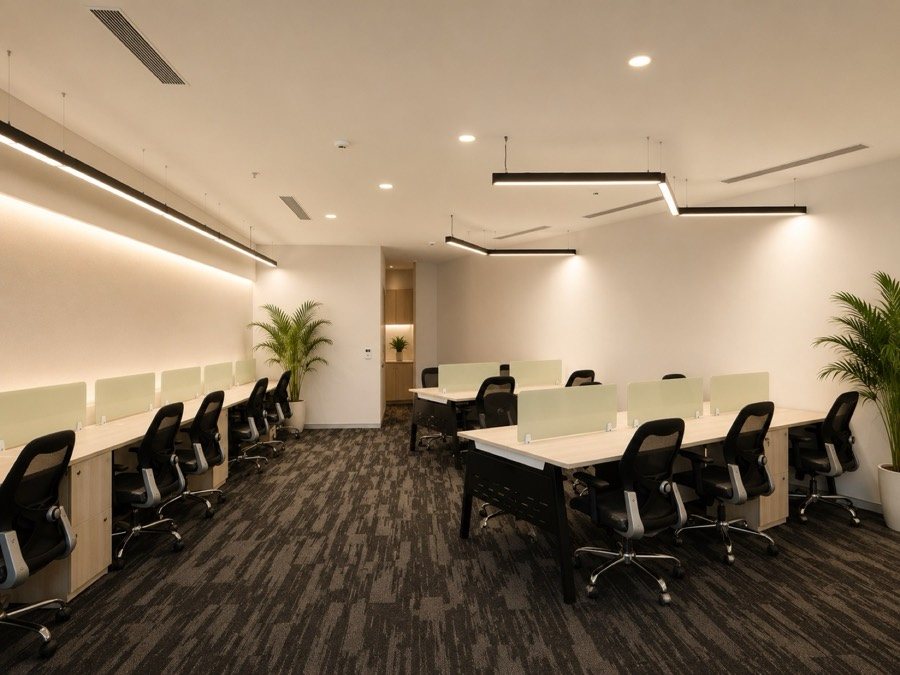
The office is where the two models diverge most visibly. A full-scale center usually leases floors or a campus, often surrounded by a flex layer for projects and surge. A Nano GCC sits in a managed private office: lockable, access-controlled, furnished and ready within days.
The risk profiles mirror each other. A Nano GCC’s office risk is low: if the mandate is cancelled, the exit is clean. Its real risk is under-investment, such as cramming a growing team into a space that no longer works. A full-scale center’s office risk is high: a long lease signed for an upside case that never arrives. Neither risk is solved by picking the “right” model once. Both are solved by matching the office to the evidence at each stage.
The triggers: when a Nano GCC should scale up
Scaling is not a date on a plan. It is a set of conditions. When most of these are true at once, it is time to plan the next stage.
- The mandate is proven. The first team has met the targets headquarters set for it for at least two consecutive quarters.
- Headquarters asks for more. A second function or product line is requested by the business, not pushed by the India team.
- A leadership bench exists. There is at least one local leader beyond the center head who could run a second team.
- The space is full. Meeting rooms are booked out, new hires are squeezed in, and visiting leaders have nowhere to sit.
- The operating route is due to change. An EOR or BOT arrangement is approaching the point where a captive entity makes sense. Confirm the structure with your CA and lawyer.
Signs you are scaling too early
- The plan for the second team depends on a budget that has not been approved.
- The first team’s results are promising but not yet measured.
- The case for a large lease rests on a five-year headcount curve rather than the next 12 months.
- No one at headquarters owns the expanded mandate.
An illustration: the same company, two plans
Consider a mid-sized software company in Europe that wants an India data engineering capability. The numbers below are illustrative, not quotes, but the shape of the decision is typical.
Plan A, full-scale from day one. The company forms a captive entity, leases a floor sized for 150 people on the assumption that the center will reach that size in three years, and funds a fit-out. The first hires start several months after approval. In year one, the center has 30 people on a floor built for 150, and the CFO at headquarters sees a large capex line and a cost per occupied seat far above plan.
Plan B, Nano GCC first. The company hires a senior data leader through an employer of record, takes a lockable managed private office for a team of 15 to 20, and starts work within weeks. After two quarters the team has delivered against its targets, and headquarters asks for a second team in analytics. The center adds cabins in the same building, moves to a captive entity on advice, and begins modelling a leased core for the stable part of the team.
Plan B may end up at the same 150 people as Plan A. The difference is that every commitment along the way was backed by evidence, and the capital was spent only when the case was proven. If the mandate had been cancelled in month nine, Plan B would have exited cleanly; Plan A would still be paying for a floor.
Questions to settle with headquarters before you choose
Before committing to either model, get clear answers to a short list of questions. They decide the size of the first step more reliably than any benchmark.
- What does success look like in 12 months? If no one can say, start as a Nano GCC.
- How many functions are committed, not hoped for? One committed function points to a Nano GCC; three or more may justify scale.
- Who owns the India mandate at headquarters? A single sponsor suits a compact team; several sponsors need full-scale governance.
- How long can the budget be guaranteed? A one-year budget should not sign a multi-year lease.
- How sensitive is the work? Security needs apply at any size, so make sure even the first office meets the parent’s policy.
Scaling without a disruptive move
The step from Nano to full-scale does not have to be a leap. Most centers pass through an in-between stage: two or three teams, 50 to 150 people, still mostly in managed space, with a leased core under consideration. The practical goal is to make that stage boring. Add cabins and meeting rooms in the same building where possible, keep security and IT standards consistent, and move only when the numbers favor a leased core. Our post on expandable office space from 20 to 200 seats covers what to ask for in writing.
The demand data supports this path. Cushman & Wakefield reports that GCCs took 44% of all flexible workspace seats leased in India in H1 2026, which suggests many centers, not only small ones, are choosing flex space over long leases while they grow.
In Gurugram, QAARYA’s three buildings give a Nano GCC room to start and grow in a known address: M3M IFC on Golf Course Extension Road, DLF Building 14 in Cyber City and AIPL Masterpiece on Golf Course Road. Cabin, desk and meeting-room configurations can be adjusted as a team grows, and layout and branding can be tailored to match headquarters. The Nano GCC page sets out the stages from pilot team to scale-up. For availability and pricing at the size you need, ask during a tour.
The choice between a Nano GCC and a full-scale GCC is not about ambition. It is about evidence. Start at the size the evidence supports, and scale at the speed it arrives.
Starting small, planning to scale? See how QAARYA sets up offices for Nano GCCs that grow in place, or talk to the team on +91 96504 98482.
Frequently asked questions
What is the difference between a Nano GCC and a full-scale GCC?
A Nano GCC is a small capability center, typically starting with roughly 10 to 50 people and one narrow mandate, built to prove value quickly. A full-scale GCC runs many functions with hundreds or thousands of people, with its own governance, leadership layers and long-term real estate.
Is a Nano GCC cheaper than a full-scale GCC?
A Nano GCC has a much smaller total budget and avoids fit-out capex and empty seats, but its cost per seat can be higher than a mature large center. The right comparison is total cost per occupied seat over the period in which the mandate is being proved.
How fast can a Nano GCC launch compared with a full GCC?
Vendor guides commonly estimate that hiring through an employer of record can start in one to two weeks, a managed GCC can go live in 6 to 16 weeks, and a wholly owned captive takes 16 to 24 weeks or more. A Nano GCC in a managed office can usually start at the faster end.
When should a Nano GCC scale into a full-scale GCC?
A Nano GCC should scale when its first team has met its targets for at least two consecutive quarters, headquarters asks for a second function, a local leadership bench is in place and the team has outgrown its space. Scaling on hope rather than evidence is the most common mistake.
Does a Nano GCC need to move offices when it scales?
Not necessarily. If the first office is in a managed building where cabins, desks and meeting rooms can be added, a Nano GCC can grow in place for some time. A move or a leased core usually makes sense only once headcount is large and stable.