Premium Managed Offices

Key takeaways
- A Nano GCC is a deliberately small global capability center in India, typically starting with roughly 10 to 50 people, with one narrow mandate and senior high-impact compact teams.
- It is still a GCC: the parent owns the mandate, the IP and the outcomes. That separates it from outsourcing, where a vendor owns delivery, and from an EOR, which is an employment route rather than a center.
- The model is growing because smaller companies now build GCCs: Nasscom-Zinnov counts 583 mid-market GCCs and 504 PE-backed GCCs among India’s 2,117.
- Cushman & Wakefield says GCCs took 44% of all flexible workspace seats leased in India in H1 2026, which is where most Nano GCCs sit.
- A Nano GCC needs a lockable private office, meeting rooms for global calls, long access hours and room to add cabins, not a leased floor and a fit-out project.
- Rule of thumb: start with one function, one leader and one office you can occupy in days. Expand only when the first team has proved its mandate.
For most of the last two decades, a global capability center in India meant a campus: hundreds or thousands of people, a leased tower, a multi-year build. That picture is still accurate for the largest centers. It is no longer the only picture. A growing number of companies are opening centers with a single team, a single leader and a single mandate. We call that a Nano GCC.
The term gets used loosely, so this post sets out a precise definition, what a Nano GCC typically does, how it differs from a full GCC, BOT, EOR and plain outsourcing, why the model is growing, and what kind of office it actually needs on day one.
What is a Nano GCC?
A Nano GCC is a small, focused global capability center in India that does real work for a parent company abroad. It typically starts with roughly 10 to 50 people. It has a narrow mandate: one product line, one analytics function, one platform team or one slice of finance operations. And it is built around high-impact compact teams: a small number of senior people who own outcomes end to end, rather than a large pool of junior capacity.
Three features define it.
- Ownership. The parent owns the mandate, the intellectual property and the results. The team works as part of the company, not as a supplier to it.
- Focus. One clear mandate, measured by outcomes headquarters cares about. Not a general “India office” that collects odd jobs.
- Seniority. The first hires are experienced specialists and a leader who can run the center, not a graduate intake.
There is no official headcount threshold. Industry coverage, such as Business Today’s 2026 feature on the trend, uses “nano” or “micro” GCC for centers from a few dozen to a few hundred people, often under 100. We use the tighter 10-to-50 band because that is where the office decision behaves differently: below a floor plate, above a coworking desk.
What a Nano GCC typically does
The functions that fit a Nano GCC share a trait: a small, senior team can produce visible results within a few quarters. According to Business Today’s reporting, ANSR’s chief executive estimates that 60 to 70% of new GCC activity is in technology, with the rest spread across marketing, design, customer success, IT and procurement. In practice, Nano GCCs commonly start with:
- An engineering pod that owns one product component or platform service.
- A data and analytics team serving one business unit.
- A finance and accounting operations team, often reconciliations, reporting or FP&A support.
- A customer success or technical support function that covers late hours for other regions.
- A cybersecurity or security operations capability.
- A niche R&D or AI team working on a specific problem.
The common mistake is to start with three of these at once. A Nano GCC proves itself fastest with one mandate and one leader who is accountable for it.
How a Nano GCC differs from a full GCC, BOT, EOR and outsourcing
Much confusion comes from mixing two different questions. Nano versus full-scale is about size and mandate. EOR, BOT or captive is about the legal and operating route. Outsourcing is a different thing entirely: buying a service rather than building a capability. The table separates them.
| Model | What it is | Who owns the work | Typical office need |
|---|---|---|---|
| Nano GCC | A small center (roughly 10 to 50 people) with one mandate and senior compact teams | The parent | Lockable private office in managed space, ready in days |
| Full-scale GCC | A large center, often hundreds or thousands of people, with many functions | The parent | Leased floors or campus, often alongside flex space |
| EOR pilot | An employer of record legally employs the team before the parent has an entity | The parent directs the work; the EOR is the legal employer | Small private office or cabins, often contracted by the parent or partner |
| BOT | A partner builds and runs the center, then transfers it to the parent | The parent, with the partner operating until transfer | Space that can transfer with the center |
| Outsourcing | A vendor delivers a service under contract with its own staff | The vendor, against a contract | None for the client; the vendor provides it |
The practical point: a Nano GCC can sit on any of the three operating routes. Our post on BOT, captive and EOR models covers how each changes the office contract. Vendor guides commonly put EOR hiring at one to two weeks and a wholly owned captive at 16 to 24 weeks or more, which is why many Nano GCCs start on an EOR or a managed partner and move to a captive later.
Why it is not outsourcing
Business Today quotes ANSR’s estimate that third-party providers typically add a 30 to 50% mark-up on talent costs. That mark-up is the visible cost. The less visible one is that knowledge, process and talent sit with the vendor. A Nano GCC keeps both inside the company, which is the reason to build rather than buy.
Why the Nano GCC model is growing
The data does not track “Nano GCCs” as a category, but it shows the forces behind them clearly.
- GCCs are no longer only for giants. The Nasscom-Zinnov India GCC Landscape Report 2026 counts 2,117 GCCs across 3,728 units, employing about 2.36 million people. Among them are 583 mid-market GCCs and 504 PE-backed GCCs: companies far smaller than the Forbes Global 2000.
- Demand has shifted toward smaller parents. ANSR’s chief executive told Business Today that about 60% of demand in the previous year was for mid-market GCCs.
- GCCs are choosing flexible space. Cushman & Wakefield reports that flex operators leased 191,306 seats across India’s top eight cities in H1 2026, and that GCCs accounted for 44% of them.
- The mandate has moved from cost to capability. A small team of senior engineers, analysts or finance specialists can own meaningful work, so a center does not need hundreds of people to matter.
Put together, the picture is consistent: more companies want an India capability, many of them are not large enough for a campus, and they are using flexible, serviced space to start. For the wider context, see why global companies are moving capability centers to India.

What office does a Nano GCC need?
This is where the Nano GCC differs most from a full-scale center. A campus optimizes for cost per seat over ten years. A Nano GCC optimizes for speed, security and optionality over the first two.
The day-one office checklist
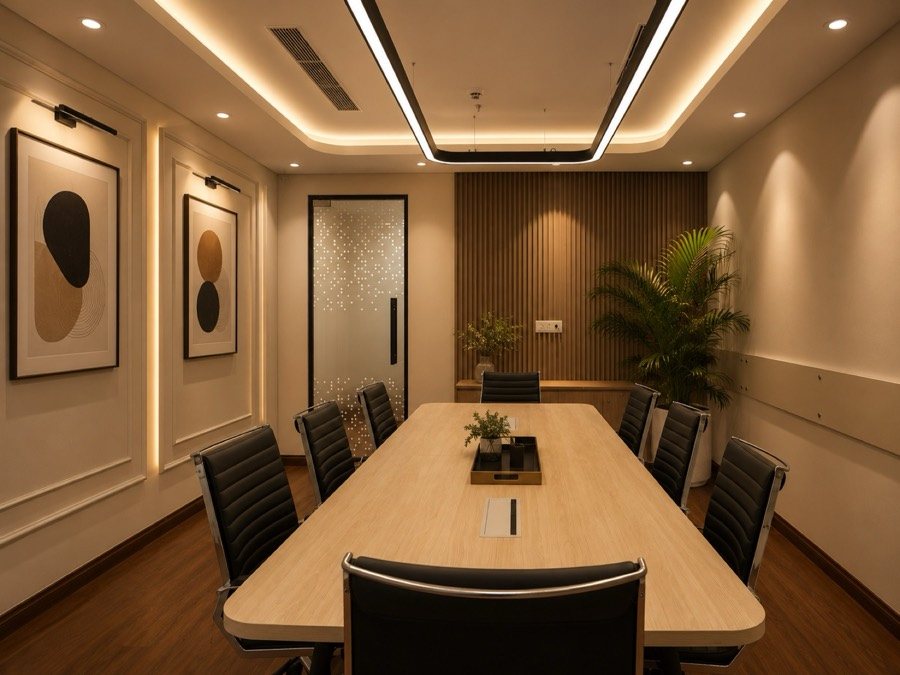
- A lockable private office. Not a desk in an open floor. The parent’s security policy applies from the first day, whatever the headcount.
- Occupancy in days, not months. The office should never be the item that delays the first hire.
- Meeting rooms with proper AV. A Nano GCC lives on video calls with headquarters. Plan one bookable meeting room per 10 to 12 people, plus phone booths.
- Hours that cover the overlap. US and European overlap means evening calls in India. Building hours should not decide when the team can work.
- Brand and layout that match headquarters. Office customization is not vanity. A space that feels like the company helps hiring and makes visiting leaders take the center seriously.
- A path to add cabins. The second team should not force a move.
A bare-shell lease fails most of this list for a team of 25. You pay for a floor you will not fill for a year, and a fit-out project that takes months. A coworking hot desk fails the other way: fast, but not private enough for most parents’ security teams. The middle option, a managed private office, is usually the right first home. Our post on core plus flex strategy explains why the Nano GCC is the flex layer in its purest form.
The cost angle: what a Nano GCC should actually compare
Nano GCC budgets are usually approved by a CFO at headquarters who wants one number. The real comparison is not rent per square foot. It is total cost per occupied seat over the period the mandate is being proved, typically 12 to 24 months.
- Lease and fit-out: rent, deposit, fit-out capex, furniture, IT cabling, power backup, housekeeping, reception, and the cost of every empty seat while the team grows into the floor.
- Managed private office: one monthly fee covering the space and services, with no capex, and seats added when people actually join.
- Outsourcing: no office cost, but the vendor mark-up and the loss of ownership described above.
For a small center, the empty-seat cost and the capex usually decide it. A managed office costs more per seat than a mature lease, but a Nano GCC is not a mature lease. It is an experiment the parent wants to run quickly and cleanly, with the option to scale or stop. The cleanest budget line is a single monthly cost that headquarters can approve without a capex request.
How to start a Nano GCC: a short sequence
- Write the mandate in one sentence. What will this team own, and how will headquarters measure it in 12 months?
- Choose the operating route. EOR, BOT partner or captive entity, based on speed, control and the expected lifespan. Take legal and tax advice before you choose; confirm with your CA and lawyer.
- Hire the leader first. A Nano GCC lives or dies on the seniority of its first hire.
- Pick the city and corridor from the hiring map. Where do the first 10 to 20 senior hires live, and how long is their commute?
- Secure the office in parallel. Vendor guides report that running entity, hiring and workspace in parallel cuts launch timelines by 30 to 50%.
- Set a review date. Decide in advance what result would justify the second team.
Where a Nano GCC fits in Gurugram
Gurugram suits the model because its talent pool is deep in experienced finance, analytics, operations and technology professionals, and because it sits close to IGI Airport for headquarters visits. Within the city, the corridor matters. QAARYA runs managed private offices in three: M3M IFC on Golf Course Extension Road (about 15 km from the airport), DLF Building 14 in Cyber City (about 10 km from the airport, with Rapid Metro to the Yellow Line), and AIPL Masterpiece on Golf Course Road, an IGBC Platinum green building with the Sector 53–54 Rapid Metro station at its door.
For a Nano GCC, the relevant features are practical ones: fit-out-ready cabins that most teams move into within a few days of signing, layout, furniture and branding tailored to the headquarters brand, access Monday to Saturday from 9 AM to 2 AM with 24x7 access for members, and cabin and meeting-room configurations that can be adjusted as the center grows. The Nano GCC page sets out how that works. Pricing and availability depend on the configuration, so ask during a tour.
The definition is simple, and it is worth holding on to: a Nano GCC is a small team doing owned, high-value work for a parent abroad. Build it with that in mind, give it an office that is private, fast and flexible, and let it earn its next stage.
Planning a Nano GCC in Gurugram? See how QAARYA sets up offices for Nano GCCs, or talk to the team on +91 96504 98482.
Frequently asked questions
What is a Nano GCC?
A Nano GCC is a small, focused global capability center in India that does real work for a parent company abroad. It typically starts with roughly 10 to 50 people, a narrow mandate such as one product line or one analytics function, and senior, high-impact compact teams rather than large junior pools.
How big is a Nano GCC?
There is no official threshold. QAARYA uses the term for centers that start at roughly 10 to 50 people. Industry coverage uses “nano” or “micro” GCC more loosely for centers from a few dozen to a few hundred people, often under 100.
How is a Nano GCC different from outsourcing?
In outsourcing, a vendor employs the people and owns delivery against a contract. In a Nano GCC, the parent company owns the mandate, the intellectual property and the outcomes, and the team works as part of the parent, even if a partner helps with setup or employment at first.
Is a Nano GCC the same as an EOR or BOT?
No. An employer of record and build-operate-transfer are ways to set up and run a center, while a Nano GCC describes its size and mandate. A Nano GCC can start on an EOR, under a BOT partner or as a small captive subsidiary, and can change model later.
What office does a Nano GCC need?
A Nano GCC needs a lockable, access-controlled private office it can occupy within days, meeting rooms equipped for global video calls, access hours that cover overlap with headquarters, and a clear path to add cabins as it grows. A leased floor with a fit-out project is usually too big and too slow for it.
Why are companies setting up Nano GCCs in India?
Smaller and mid-sized companies now build capability centers, not only large enterprises. A Nano GCC lets them access India’s senior talent, keep ownership of the work and prove the case with a small budget before committing to a larger center.