Premium Managed Offices
Key takeaways
- Good office branding is not decoration. It is a set of signals about how the company works: open or private, formal or informal, craft-led or speed-led.
- Research by Knight and Haslam at the University of Exeter found people in enriched offices were 17% more productive than in bare ones, and 32% more productive when they shaped the space themselves.
- A 2022 study in the Journal of Environmental Psychology found that creative workspace design raises how attractive an employer looks to candidates.
- Rule of thumb: brand the three moments that matter, the entrance, the main meeting room and the team’s daily wall, before anything else.
- Most branding in a private office can be done with reversible layers: signage, graphics, furniture, colour accents and objects, with no fit-out capex.
- Keep the logo to one or two places. The rest of the space should show the work, the values and the way the team actually operates.
Most office branding begins and ends with the logo. A vinyl decal behind reception, a branded mug in the pantry, perhaps a slogan on the wall. Then everyone wonders why the office still feels like anyone’s office.
The reason is simple. A logo tells people whose space it is. It says nothing about what kind of company works there. Real office branding works at a different level: the entrance, the materials, the way rooms are named, what is on the walls and how the layout lets people work. Each one is a signal. Together they tell a client, a candidate or a new hire how this company thinks. This post covers the elements that matter, what actually impresses visitors, and how to make a branded private office without a full fit-out.
Why office branding is really about culture
Every office communicates something whether or not anyone designed it to. A silent floor with closed doors says focus and privacy. A long communal table says collaboration. A reception with framed press clippings says the company cares about reputation. Visitors read these signals in seconds, and so do the people who work there every day.
The practical question is not whether your office has a brand. It is whether the brand it has matches the company you are trying to be. A consulting firm that sells rigor should not have a reception cluttered with stray deliveries. A product studio that sells creativity should not look like a bank branch. Misalignment is the most common office branding failure, and it costs nothing to notice.
What the research says about personalised space
There is decent evidence that how a workspace is shaped affects both the people in it and the people looking at it.
The most-cited work comes from Craig Knight and Alex Haslam at the University of Exeter, published in 2010 in the Journal of Experimental Psychology: Applied. They compared four conditions: a lean office (bare and functional), an enriched office (with plants and pictures), an empowered office (where people arranged the space themselves) and a disempowered one (where a manager rearranged it after them). People in enriched offices were 17% more productive than those in lean ones, and people in empowered offices were 32% more productive, without more errors. The work was partly carried out with a company that sells workspace enrichment services, which is worth bearing in mind, but the direction is consistent with later research.
On the candidate side, a 2022 study in the Journal of Environmental Psychology, titled “Saw the office, want the job,” found that creative workspace design made organizations more attractive as employers than conventional design, with a stronger effect among more creative candidates. And Gensler’s 2024 Global Workplace Survey of more than 16,000 office workers in 15 countries reported that 97% of the most engaged employees were likely to stay with their company the following year, against 53% of the least engaged, with high-performing workplaces strongly associated with the most engaged and innovative teams.
The lesson is not that wall graphics produce a 32% productivity gain. It is that a space people recognise as theirs, and that they had a hand in shaping, tends to work better than one that is neutral or imposed.
The elements of a branded private office
Office branding has six main levers. You do not need all of them. Pick the ones that say the most about how your company works.
1. The entrance and signage
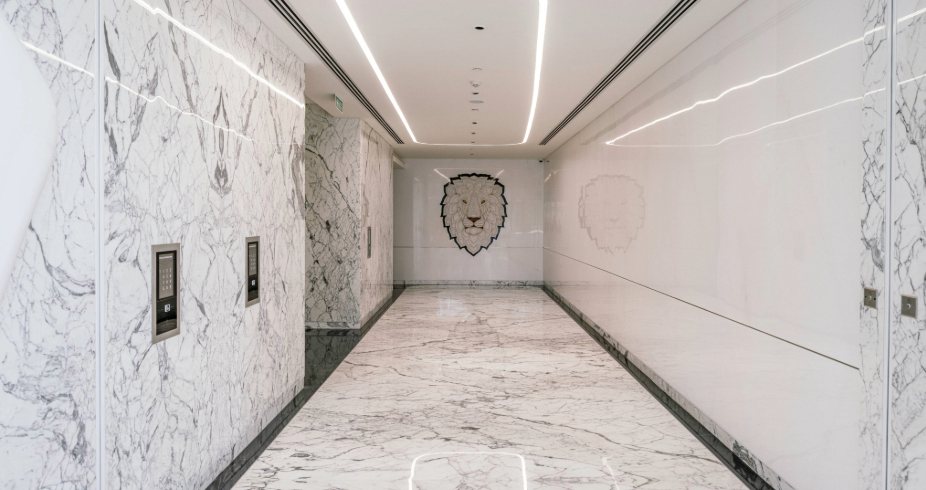
The entrance is the first five seconds of every visit. A clean, well-lit door or reception wall with your name, in your typeface, at the right scale, does more than any amount of branding inside. Keep it understated. Check the building’s rules on signage size and placement before you design anything.
2. Colours and materials
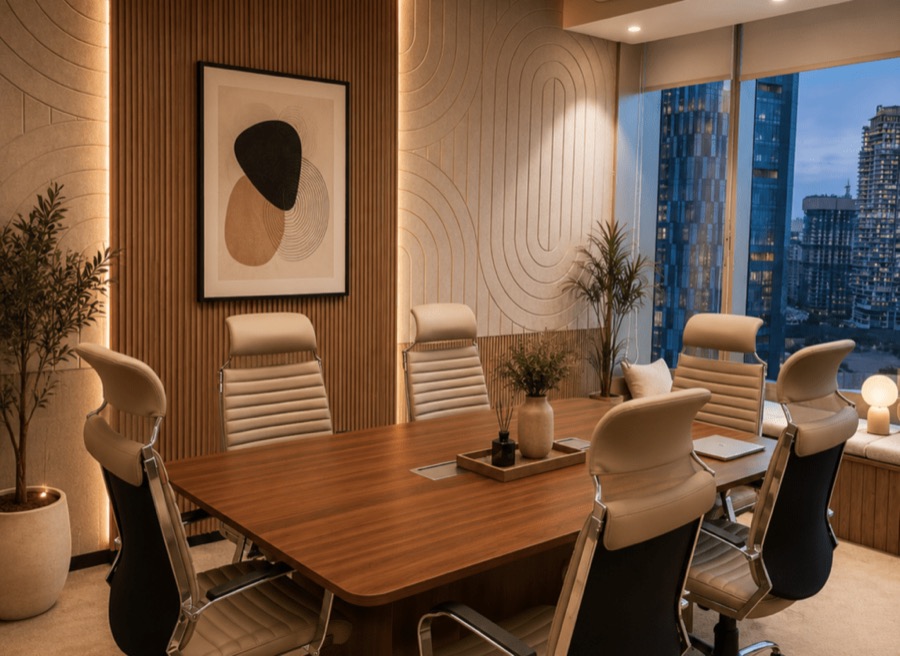
Brand colours work best as accents: a feature wall, upholstery, a rug, cabinet fronts. Painting every surface in the brand palette quickly becomes tiring. Materials carry their own message. Timber and textured fabric feel warm and crafted; glass and metal feel precise; plants soften both.
3. Wall graphics and art
Large-format graphics, wall film on glass partitions and framed artwork are the fastest way to change how a room feels. The strongest graphics are specific: a map of the markets you serve, a timeline of the company, an enlarged product drawing, a photograph of your team’s work. Generic motivational slogans are the weakest.
4. How rooms are named
Room names are a small, cheap and surprisingly effective culture signal. Naming meeting rooms after your products, your first clients’ cities, rivers, scientists or local landmarks tells visitors something about what the company values. It also makes booking easier than “Meeting Room 3B.”
5. Display of work and values
A wall of shipped products, client logos you have permission to show, awards, team photos or a handwritten values board shows rather than tells. Candidates in particular look for evidence that the values are lived, not laminated.
6. Layout choices that signal how you work
Layout is branding too. A founder who sits at the team table rather than in a corner cabin sends a message about hierarchy. A large shared table signals collaboration; rows of focus desks with a quiet rule signal deep work. Our post on private office layouts for small teams covers the options in detail.
What impresses clients and candidates
Clients and candidates notice different things, but both are reading for the same underlying question: is this a serious, well-run company?
| Element | What clients notice | What candidates notice | Priority |
|---|---|---|---|
| Entrance and signage | Clear arrival, professionalism, no confusion at the door | Whether the company looks established | High |
| Main meeting room | Tidy, prepared, working AV, a view or good light | Where they will be interviewed and how they are treated | High |
| Work on display | Evidence of capability and track record | What they would get to work on | High |
| Team space and layout | Whether the team looks focused and organised | How people actually work day to day | Medium |
| Colours and materials | Overall quality and care | Whether the place feels pleasant to spend time in | Medium |
| Room names and small details | Personality, memorability | Culture and humour | Low cost, worth doing |
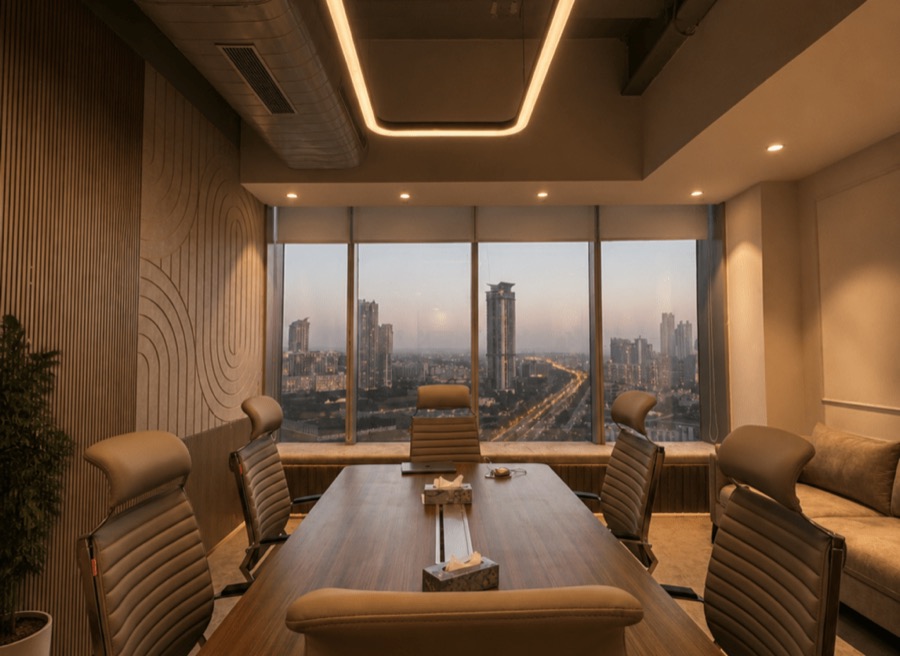
A practical rule follows: brand the three moments that matter first. The entrance, the main meeting room and the wall the team looks at every day. Our post on the hidden cost of a bad first-impression office explains why the arrival experience carries so much weight.
Branding without a full fit-out
Many teams assume that a branded office means a conventional lease and a long fit-out. It does not. Most of the branding signals above can be added as reversible layers inside a private office that is already furnished and running.
- Signage: door plates, reception panels and directional signs can be made and installed in days.
- Graphics: removable wall vinyl and glass film give a strong look and come off cleanly when you leave.
- Framed work and objects: products, models, photographs and awards need nothing more than hooks and shelves.
- Furniture and soft furnishings: chairs, rugs, cushions and lamps in brand colours change a room more than paint does.
- Plants: one of the cheapest ways to enrich a space, and consistent with the research above.
- Room names: a set of door signs and an update to the booking system.
The deeper customizations, such as layout changes, finishes and custom furniture, are where a managed office earns its place. Our post on office customization in a managed office covers what can be changed and how to agree it.
The cost logic: brand the experience, not the square footage
A conventional fit-out puts most of the branding budget into permanent construction: walls, ceilings, built-in joinery. When the company moves or outgrows the space, that money stays behind. Reversible branding does the opposite. It concentrates spend on the things people actually see and touch, and most of it moves with you.
As an illustration, not a quote: a small team that spends on signage, graphics, framed work, a few pieces of furniture and plants is spending a fraction of a fit-out budget, and can carry much of it to the next office. Measured against the value of one client won or one senior hire accepted, the return is easy to justify.
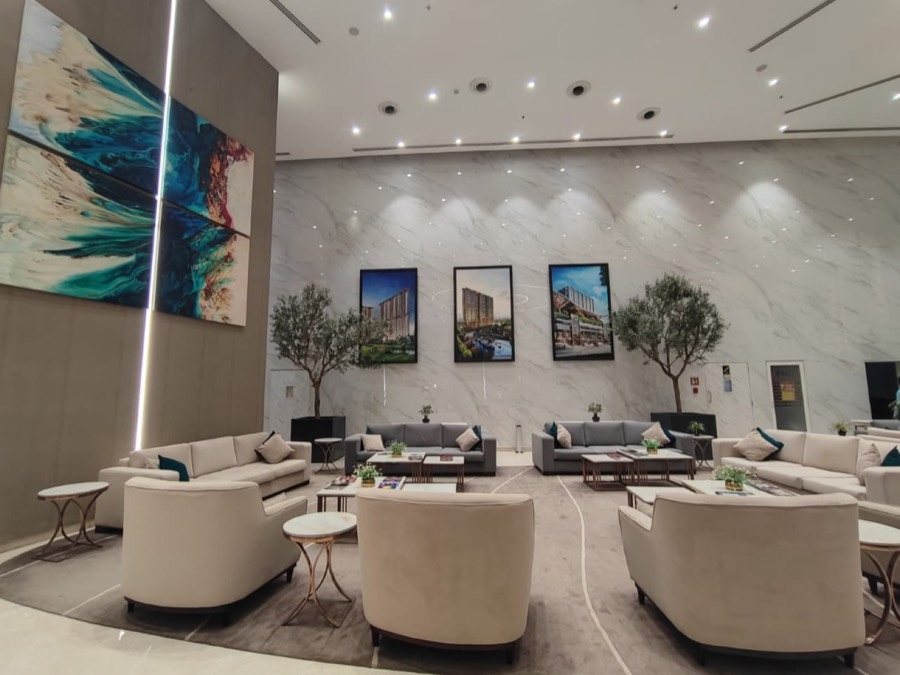
In Gurugram, QAARYA’s private offices are designed for this approach. Layout, furniture, finishes and branding can be tailored to match a company’s headquarters or brand, and cabins are fit-out ready, so most teams move in within a few days of signing and add their own identity on top. The three buildings set different tones of their own: the polished lobbies of M3M International Financial Centre on Golf Course Extension Road, the business energy of DLF Building 14 in Cyber City, and the green-certified AIPL Masterpiece on Golf Course Road. Custom requirements are quoted upfront, so the branding plan and its cost are clear before you commit.
A four-step plan for your first month
Branding a new private office works best as a short, deliberate project rather than a slow accumulation of objects. A simple sequence keeps it focused and keeps the team involved.
- Week 1: write three words. Agree, as a team, three words that describe how you work, such as “precise, calm, client-first” or “fast, open, hands-on.” Every later choice should support at least one of them.
- Week 2: fix the three moments. Order entrance signage, prepare the main meeting room and choose what goes on the team wall. These carry most of the impression.
- Week 3: add the layers. Graphics, room names, furniture accents and plants. Let each team member choose or contribute one item for their own area; ownership matters more than polish.
- Week 4: walk it as a visitor. Arrive from the lift as a client would, then as a candidate would. Remove anything that does not support the three words.
Revisit the plan every six months. As the team grows, the work on the walls should change with it; an office that still shows last year’s wins quietly tells visitors that nothing has happened since.
Common office branding mistakes
- Logo everywhere. Repetition reads as insecurity, not confidence.
- Slogans instead of evidence. “We value innovation” on a wall persuades nobody. A shelf of shipped products does.
- Designed by committee, imposed on the team. The Exeter research suggests people work better in space they help shape. Involve the team.
- Ignoring the meeting room. It is where clients spend most of their visit and candidates spend their interview.
- Permanent work in a temporary space. Paint and built-ins you cannot take with you are a cost, not an asset.
A branded office is not one with the most logos. It is one where a visitor can guess, within a minute, what the company values and how it works. Start with the entrance, the meeting room and the team wall, use reversible layers, and let the space show the work. See QAARYA’s private office solutions to find a space you can make your own.
Want a private office in Gurugram that looks and works like your company? See QAARYA’s private office solutions, or talk to the team on +91 96504 98482 about branding your space.
Frequently asked questions
What is office branding?
Office branding is the use of signage, colour, materials, graphics, furniture and layout to make a workspace express a company’s identity and culture. Done well, it tells clients and candidates how the company works, not just what its logo looks like.
Can you brand a private office in a managed or serviced building?
Yes, in most managed offices. Operators commonly allow door signage, wall graphics, furniture choices and colour accents inside a private office, and some will tailor layout, finishes and branding to match a company’s headquarters. Confirm in writing what is allowed and who restores the space when you leave.
Does office design really affect productivity?
Research suggests it does. A University of Exeter study by Craig Knight and Alex Haslam found people in offices enriched with plants and pictures were 17% more productive than in bare offices, and 32% more productive when they could arrange the space themselves.
What office branding ideas impress clients?
Clients notice a clear, well-lit entrance with your name, a meeting room that is tidy and set up for them, and visible evidence of your work, such as projects, products or results. Over-branding, with logos on every surface, tends to look insecure rather than impressive.
How do you brand an office without a full fit-out?
Use reversible layers: door and reception signage, removable wall graphics or film, framed work, furniture and soft furnishings in brand colours, named meeting rooms and a values or wins wall. These can be installed in days and removed when you move.
How much of an office should carry the company logo?
Very little. A good rule is the logo at the entrance and in the main meeting room, and nowhere else. The rest of the space should express culture through materials, objects, work on display and how rooms are arranged.