Premium Managed Offices

Key takeaways
- A professional firm’s office has one non-negotiable job: no client conversation should be overheard by anyone outside the room.
- Confidentiality is a professional duty, not a preference. Advocates are bound by Section 132 of the Bharatiya Sakshya Adhiniyam, CAs by ICAI’s Code of Ethics, and anyone handling personal data by the DPDP Act’s security obligations.
- Plan the seat mix by role: an enclosed cabin for every partner, a shared private room for associates, and at least one bookable meeting room per 8 to 10 people for a client-heavy practice.
- Open coworking floors suit solo research days, not client work. A private office with a door that locks is the realistic minimum for a practice.
- For practices of roughly 3 to 40 people, a managed private office usually beats a self-fitted lease on time, capex and the quality of client-facing space.
- Choose the corridor by where clients and staff come from, then test the building on a weekday afternoon, not a quiet Saturday.
A law firm, a CA practice and a strategy consultancy look different on a website, but they sell the same thing: judgment that a client trusts enough to share sensitive facts with. The office is where that trust is tested. A client who hears the next room’s conversation through the wall draws an obvious conclusion about what the next room can hear of theirs.
Most office advice is written for startups that want energy, open floors and a ping-pong table. Professional practices need almost the opposite: quiet, discretion, rooms that close, and a front door that reassures a CFO or a promoter walking in for the first time. This guide sets out what law, CA and consulting firms in Gurugram should demand from their space, and how to choose between the options.
Confidentiality is a duty, not a design preference
For professional firms, confidentiality is written into the rules of the profession. Treat the office as part of how you meet those rules.
Advocates are bound by Section 132 of the Bharatiya Sakshya Adhiniyam, 2023, which carries forward Section 126 of the old Indian Evidence Act and bars an advocate from disclosing communications made by a client in the course of professional engagement without the client’s consent. The Supreme Court reaffirmed the strength of that privilege in a 2025 ruling on investigators summoning lawyers. Chartered accountants work under ICAI’s Code of Ethics, which lists confidentiality among its fundamental principles. And any firm that holds personal data about clients or their employees, which is nearly every practice, has obligations under the Digital Personal Data Protection Act, 2023, including taking reasonable security safeguards to prevent a breach. The DPDP Rules notified in November 2025 are being phased in, so check which provisions already apply to you.
None of these rules say anything about partition walls. But each assumes that the professional controls who can hear, see and access client information. An office that leaks sound, leaves files in shared areas or lets strangers wander past screens makes that assumption hard to keep. This is a general overview, not legal advice: confirm your specific obligations with your lawyer or your institute.
The five things a professional firm’s office must do
Strip away the finishes and a practice’s office has five jobs. Score every option against them.
1. Keep conversations private
Acoustic privacy is the first test and the one most often failed. Glass-fronted meeting rooms look elegant, but a thin partition with a gap above the ceiling tile carries speech straight into the corridor. The standard to hold: a person standing outside a closed meeting room should hear that someone is talking, not what they are saying. Partners who take sensitive calls need a cabin with a solid door, not a desk in a pod.
2. Protect documents and data
- Controlled access: only your people and the operator’s authorized staff should be able to enter your suite, with visitors received and escorted.
- Lockable storage: case files, audit papers and signed engagement documents need locked cabinets inside your own space, not a shared storeroom.
- Printing: a shared printer on an open floor is the most common leak in a professional office. Ask for a printer inside your suite or secure release printing.
- Network separation: client data should not travel over the same open Wi-Fi as every other tenant. Ask how the network is segmented and whether you can bring your own firewall.
- Screens and sightlines: desks facing a corridor wall of glass expose whatever is on the monitor. Check sightlines before you sign.
3. Host clients well
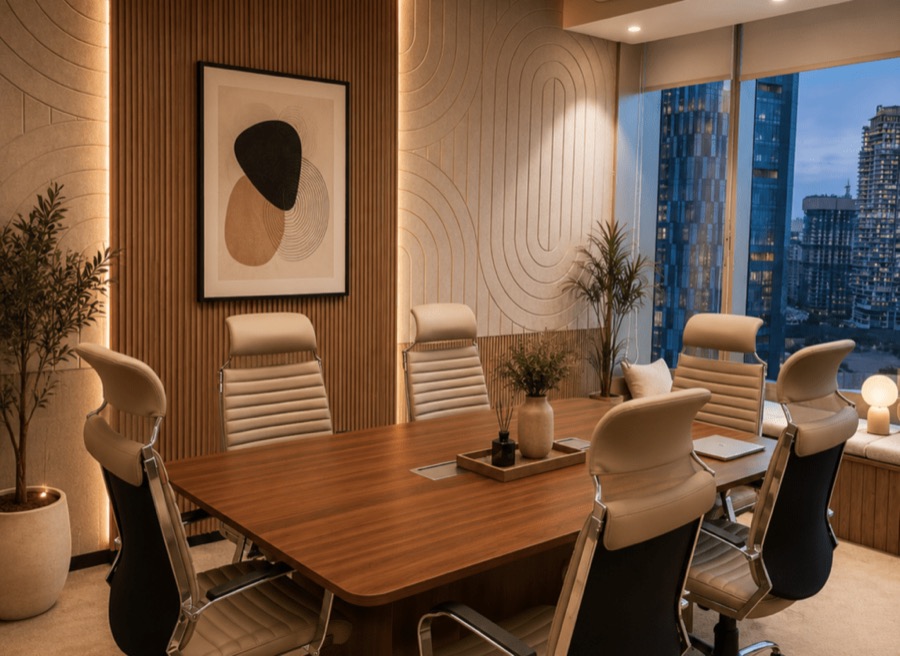
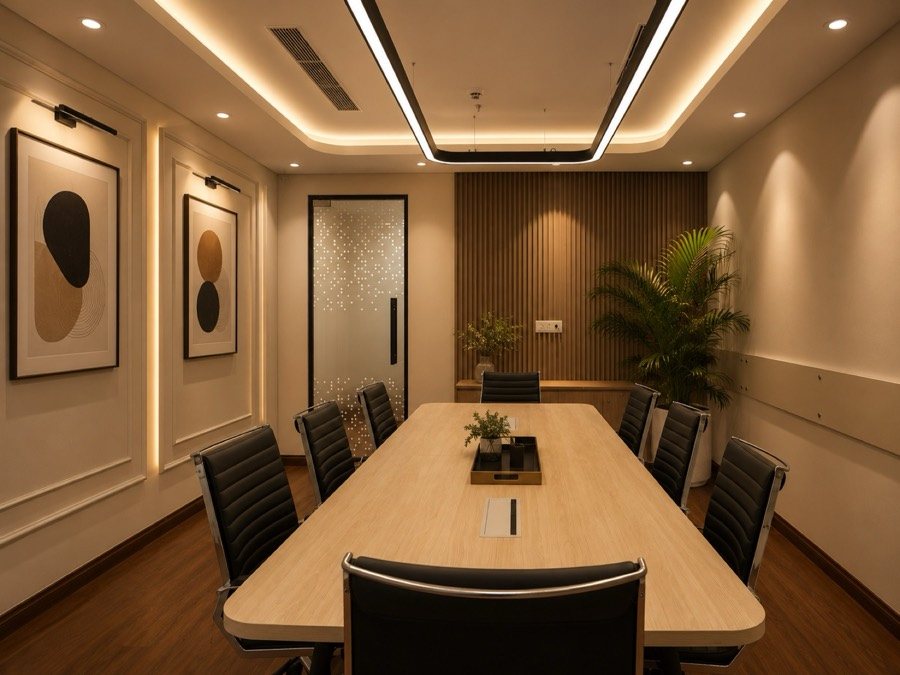
Professional firms meet clients more often than most businesses of their size, and those meetings carry money. A board meeting on a transaction, a tax assessment review with a promoter, a steering committee for a consulting engagement: each needs a room with a proper table, good light, a screen that works first time and coffee that arrives without anyone leaving the room. Our piece on how an office shapes a client’s first impression covers why these details matter more than their cost suggests.
4. Give the practice a credible address
The address on a letterhead, an engagement letter and a GST registration does quiet work. A Grade A building in a known business district tells a new client that the practice is established and solvent. That matters most for firms that grow by referral and reputation rather than advertising, which describes most practices.
5. Be reachable for clients and staff
A practice serving corporate clients wants to be close to where those clients sit and to where its own associates live. In Gurugram that usually means one of the main commercial corridors, with metro access for staff and reasonable road time to the clients the firm visits most. Keep location reasoning concrete: list your top 20 clients and your team’s home areas, and time the drive or metro ride at 10 a.m. and 6 p.m.
Partners, associates and the seat mix
Professional firms are hierarchical in a way that should shape the floor plan. A partner who closes a door for a call with a client is doing core work, not claiming status. An associate drafting a memo needs focus, but rarely privacy from colleagues. Staff who handle client records need controlled space, not exposure to visitors.
A rule of thumb that works for most practices:
- Partners and directors: one enclosed cabin each, with a door and room for one or two visitors.
- Associates, articled assistants and analysts: desks in a private team room that only the firm uses, with a couple of quiet spots for calls.
- Support and accounts staff: desks inside the suite, near the locked storage, away from the visitor route.
- Meeting rooms: roughly one bookable room per 8 to 10 people for a client-heavy practice, plus access to a larger board room when a full committee or a client team arrives.
That meeting-room ratio is higher than a typical office needs, because a practice holds more external meetings per head. For the general case, see our guide on how many meeting rooms an office needs.

Needs versus options: a quick comparison
Professional firms in Gurugram usually choose among four set-ups. Here is how each scores against the five jobs above.
| Need | Virtual office | Coworking desk | Managed private office | Leased and self-fitted |
|---|---|---|---|---|
| Acoustic privacy | Only in booked rooms | Weak on open floors | Strong if cabins and rooms are properly built | Strong, if you pay for it in fit-out |
| Document and data control | Not applicable day to day | Weak: shared space and printers | Good: lockable suite, your own storage | Full control, full responsibility |
| Client meetings | Bookable rooms | Bookable rooms, busy floor | Own rooms plus on-demand board rooms | Only the rooms you build |
| Address credibility | Good, at low cost | Good | Good | Depends on the building |
| Time to occupy | Days | Days | Typically weeks | Often several months |
| Upfront capex | None | None | None or minimal | High: fit-out, furniture, IT |
| Best fit | Solo practitioners, new practices | Occasional desk days | Practices of roughly 3 to 40 people | Larger, stable firms |
The ranges are illustrative and vary by building and operator. The pattern is consistent, though: the open floor fails the confidentiality test, and the self-fitted lease passes it at a cost in cash and time that most small practices should not carry. A solo advocate or a new CA practice still building a client list can start with a virtual office and registered address, then move into a private office once staff are handling client files every day.
Why managed private offices suit small and mid-size practices
The economics of a professional firm are simple. Revenue comes from billable or chargeable hours, and partners’ time is the scarcest input. Every hour a partner spends approving carpentry, chasing an internet provider or negotiating with a landlord is an hour not spent on a client.
A self-fitted lease asks for exactly that time. It also asks for capital: deposits, fit-out, furniture, acoustic treatment, IT cabling and a reception that looks the part. For a ten-person practice, that money is often better spent on hiring or on a working-capital cushion through slow collection months.
A managed private office reverses the trade. The operator carries the fit-out and the building relationship; the firm pays a monthly fee for a finished, enclosed suite with shared reception and meeting rooms. Three points matter most for a practice:
- Client-facing quality on day one. A small firm gets a lobby, reception and board room it could not justify building for itself.
- Room to resize. Practices grow in steps: a new partner joins with two associates, or a large engagement needs a project team for six months. A managed operator can usually add cabins or rooms faster than a landlord can.
- Predictable cost. One monthly line is easier to budget than rent plus maintenance plus repairs plus the replacement chair nobody planned for.
A simple way to compare cost
Do not compare the managed office fee to the bare rent of a lease. Compare it to the full monthly cost of the lease: rent, maintenance charges, fit-out and furniture spread over the term, utilities, housekeeping, reception staff, internet, and the partner time spent running the office. Then add the cost of the meeting rooms and board room you would need to build to host clients properly. Most small practices that do this arithmetic honestly find that the gap is far narrower than the headline rent suggests, and that the managed option buys better client space for the money.
Where in Gurugram: matching corridor to practice
Location advice for professional firms is personal: it depends on where your clients and people are. A few general patterns help frame the choice.
Practices serving large corporates and multinationals tend to favor established business districts, where many of their clients’ offices already sit and where a visiting general counsel or CFO can arrive by metro. QAARYA’s DLF Building 14 in DLF Cyber City fits that profile, with Rapid Metro access linking to the Yellow Line at Sikanderpur and Cyber Hub next door for an informal client lunch. Firms whose clients and partners are concentrated around Golf Course Road can look at AIPL Masterpiece in Sector 54, where the Sector 53–54 Rapid Metro station abuts the building. Practices tracking the newer commercial growth along Golf Course Extension Road, including many mid-size businesses and family groups, may prefer M3M International Financial Centre in Sector 66.
Whichever corridor you shortlist, test it on a Tuesday afternoon: travel from your two most important client offices, sit in a meeting room while the floor is busy, and listen.
What to check on a tour
- The corridor test. Have a colleague speak at normal volume in a closed meeting room. Stand outside. If you can follow the words, so can the next tenant.
- The cabin door. Solid or glass? Does it seal at the bottom? Is the partition built up to the true ceiling, or does it stop at a false one?
- Access after hours. Who holds keys or access cards for your suite, and is entry logged?
- Visitor route. Do clients pass other tenants’ desks or screens on the way to your rooms?
- Printing and storage. Where would your files and printer sit, and who else can reach them?
- Board room availability. How far ahead must you book, and what happens in the week of a big closing or audit deadline?
- Reception. How are visitors greeted, announced and offered a seat? Ask to watch it happen.
Anything the operator cannot answer clearly on these points is something to resolve before signing. On terms, pricing and availability, ask during a tour rather than relying on any published figure.
The bottom line for practices
A professional firm’s office is a quiet piece of risk management and a loud piece of marketing at the same time. It has to keep client conversations and documents contained, and it has to make a first-time client feel that the practice is established and careful. For most law, CA and consulting practices under about 40 people, a managed private office in a Grade A building does both at a lower total cost, and with far less partner time, than building a suite from scratch. Review QAARYA’s workspaces across Gurugram with the tour checklist above in hand, and judge each one by what you can hear from the corridor.
Setting up or moving a law, CA or consulting practice in Gurugram? See QAARYA’s private office solutions, or talk to the team on +91 96504 98482.
Frequently asked questions
What kind of office does a small law firm in Gurugram need?
A small law firm needs an enclosed private office with a lockable door, at least one meeting room where client conversations cannot be overheard, secure storage for files and a professional reception. A managed private office in a Grade A building usually provides these without the capex and fit-out time of a conventional lease.
Can a CA firm work from a coworking space?
A CA firm can use coworking for occasional desk work, but an open floor is a poor fit for client meetings and for handling confidential financial records. ICAI’s Code of Ethics treats confidentiality as a fundamental principle, so most practices are better served by a private office or cabin with controlled access.
How many meeting rooms does a professional services firm need?
A client-heavy practice should plan roughly one bookable meeting room per 8 to 10 people, which is more than a typical office. Consulting and advisory firms that hold frequent client workshops may need a larger board room on demand as well as small rooms for calls.
Is a virtual office enough for a law or consulting practice?
A virtual office can give a solo practitioner or a new practice a credible business address and mail handling, with meeting rooms booked when needed. Once the practice has staff working on client files every day, a private office becomes the more secure and practical choice.
What should professional firms check on an office tour?
Firms should stand outside a closed meeting room while someone speaks inside and check whether words are intelligible, ask who has access to the office after hours, check where printers and file storage sit, and see how visitors are received and escorted. They should also time the commute from their main client clusters at peak hour.
Why do managed private offices suit small and mid-size practices?
Managed private offices give small and mid-size practices a furnished, enclosed suite in a quality building, with reception, meeting rooms and maintenance handled by the operator. The practice avoids fit-out capex and months of setup, and can resize as partners and associates are added.